



Evaluating the True Cost of Running an Aging AC Unit During Peak Iowa Summers
The Hidden Financial Drain of an Outdated Cooling System
There is a persistent myth among homeowners that keeping an older, paid-off appliance is always the most financially responsible choice. When it comes to evaluating the true cost of running an aging AC unit during peak Iowa summers, our team at Midwest Comfort Heating & Cooling knows the reality is often the exact opposite. Your older air conditioner might not have a monthly finance payment attached to it, but it is quietly extracting a heavy toll directly from your utility budget. As temperatures and humidity levels climb, that aging system is forced into overdrive, consuming significantly more electricity just to maintain a baseline level of comfort.
The core issue lies in the monthly cash-flow comparison. Many homeowners look at the prospect of a system replacement as a massive, insurmountable lump-sum expense. However, when you factor in the exorbitant month-over-month utility bills required to nurse an inefficient system through July peak summer heat, the financial perspective shifts dramatically. You are essentially paying a high premium for substandard cooling. By exploring foundational air conditioning services and utilizing flexible HVAC financing options, you can reframe this financial drain into a predictable, manageable investment in your home's infrastructure.
Analyzing the Efficiency Gap of a 10 SEER AC Unit
To truly understand the financial impact of an older cooling system, you have to look at the underlying technology and how efficiency is measured. The Seasonal Energy Efficiency Ratio (SEER) is the standard metric used to grade an air conditioner's cooling output divided by its total electric energy input during a typical cooling season. Two decades ago, a 10 SEER AC unit was the industry standard. Today, the technological leap in compressor design, coil surface area, and fan motor efficiency means that modern systems routinely operate at 16 SEER or higher.
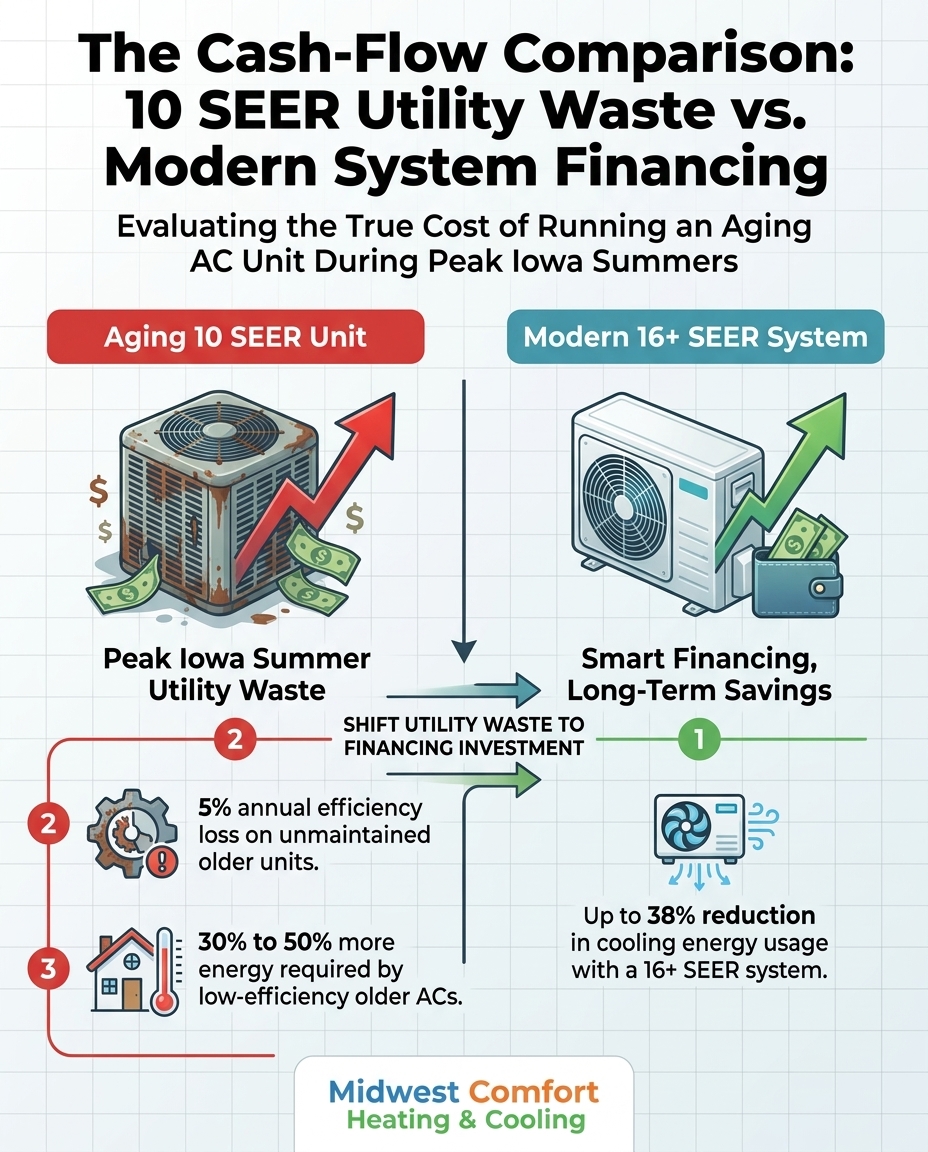
According to data from the U.S. Department of Energy, upgrading from an older standard efficiency model to a modern high-efficiency system can reduce your cooling energy usage by up to 38 percent. But the gap is often much wider than the baseline numbers suggest, due to age-related degradation. Air conditioners lose roughly 5 percent of their operating efficiency for every year they go without proper, comprehensive maintenance. In our experience servicing Des Moines neighborhoods, a 15-year-old 10 SEER system that has endured harsh midwestern weather is likely operating at a fraction of its original rating.
• Energy Consumption — Aging 10 SEER System (Degraded): Maximum electrical draw for minimal cooling output. — Modern 16+ SEER System: 30% to 50% less energy required to achieve the same cooling.
• Cycle Times — Aging 10 SEER System (Degraded): Extended, continuous running times struggling to meet thermostat settings. — Modern 16+ SEER System: Shorter, highly efficient cycles with variable speed adjustments.
• Dehumidification — Aging 10 SEER System (Degraded): Poor moisture removal, leaving the indoor air feeling sticky and warm. — Modern 16+ SEER System: Advanced latent heat removal for crisp, dry indoor air.
• Wear and Tear — Aging 10 SEER System (Degraded): High risk of component failure due to constant mechanical strain. — Modern 16+ SEER System: Minimal strain, protected by comprehensive manufacturer warranties.
Mechanical Wear and Increased Power Draw
The inefficiency of an older unit is not just a matter of outdated technology; it is a matter of physical physics and mechanical wear. As a 10 SEER AC unit ages, its internal components degrade. Our technicians routinely find failing compressors and worn-out blower motors beginning to experience increased electrical resistance. This means the system requires a significantly higher electrical load just to start up, and it continues to draw excessive amperage while running.
Furthermore, years of minor coil degradation, microscopic dirt buildup, and bent fins restrict the critical airflow needed for the heat exchange process. When the system cannot efficiently release heat outdoors, it is forced to run longer cooling cycles. This mechanical effort creates a vicious cycle: the harder the system works to compensate for its degraded state, the more electricity it consumes, and the faster its remaining components wear out.
How High Humidity Forces Continuous Operation
The problem: An air conditioner's job is twofold. It must lower the physical temperature of the air (the sensible cooling load) and it must remove moisture from the air (the latent cooling load). In a climate with dry heat, the latent load is minimal. However, during a Des Moines July peak summer, the thick, heavy midwestern air introduces a massive latent cooling load. We constantly see air conditioners working incredibly hard just to wring the water out of the indoor air before they can effectively lower the temperature.
The cause: An aging, inefficient system simply lacks the advanced coil design and variable-speed technology required to handle severe humidity efficiently. Because the system struggles to extract moisture, the air inside your home retains a high humidity level, making it feel warmer than the thermostat indicates. This forces the system into nearly continuous operation during the hottest parts of the year. The unit runs non-stop, attempting to satisfy a thermostat setting that feels perpetually out of reach because the air remains saturated with moisture.
The solution: This compounding effect of continuous operation not only causes your electric bill to spike dramatically, but it also accelerates the mechanical wear on an already fragile system. While scheduling a thorough AC tune-up guide for Iowa homeowners can temporarily mitigate some of the strain by cleaning coils and optimizing airflow, it cannot permanently solve the deep efficiency flaws of an obsolete unit. Eventually, the physics of high humidity will overpower the mechanical limits of an older system, necessitating a transition to equipment designed to handle heavy latent loads.
Monthly Utility Waste Versus System Financing
The most critical shift in evaluating your cooling costs is moving away from the idea of a lump-sum purchase and toward a cash-flow reallocation strategy. When you operate an aging 10 SEER AC unit, a significant percentage of your monthly utility budget is essentially being wasted. You are paying for electricity that is burned up in mechanical inefficiency, extended run times, and poor dehumidification. This utility waste is a sunk cost; it provides no return on investment and does nothing to improve the value or comfort of your home.
Contrast that volatile, weather-dependent utility waste with the predictable structure of a modern financing plan. High-efficiency modern air conditioners require 30 to 50 percent less energy to produce the exact same amount of cooling. When you eliminate that massive monthly energy waste, the resulting reduction in your utility bill can offset a significant portion of a new system's monthly financing payment. You are taking the funds that were previously vanishing into thin air and redirecting them toward a tangible asset that improves your daily life.
The Cash-Flow Reallocation Strategy
• Shifting funds from waste to equity: Instead of paying the utility company a premium for inefficiency, you invest that same cash flow into upgrading your home's infrastructure.
• Financial predictability: Utility bills tied to inefficient equipment fluctuate wildly based on the weather. A fixed monthly financing payment remains stable, making household budgeting much easier.
• Protection against rate increases: As local energy rates inevitably rise over time, the financial penalty for operating an inefficient system grows. A high-efficiency unit insulates you from the worst impacts of rising electricity costs.
The Compounding Risk of Emergency Peak-Season Breakdowns
Beyond the predictable month-to-month utility waste, nursing an old unit carries a severe secondary financial risk: the sudden, catastrophic breakdown. During a July peak summer heatwave, the local electrical grid is under maximum stress, and your air conditioner is experiencing maximum continuous runtimes. This relentless operational pace pushes aging components—such as capacitors, contactors, and the compressor itself—far past their breaking point.
When a 15-year-old system fails, it rarely happens on a mild afternoon. A pattern we see often is that it happens when the system is working its hardest, which is exactly when HVAC companies are at their busiest. The out-of-pocket reality of emergency repairs on out-of-warranty equipment can be staggering. You are suddenly faced with paying premium rates for major component replacements on a system that is still fundamentally obsolete and inefficient.
This reality sharply contrasts with the peace of mind provided by a new unit. Modern systems are backed by comprehensive manufacturer warranties that protect you from unexpected repair costs for years to come. While enrolling in a proactive preventative maintenance plan is an excellent way to monitor these risks and keep an older system limping along, maintenance alone cannot reverse fundamental obsolescence. Eventually, the compounding risk of a peak-season breakdown outweighs the perceived savings of delaying a replacement.
Utilizing Tools to Project Your Cooling Budget
Taking control of your household expenses begins with understanding the specific math of your current situation. You do not have to guess whether upgrading makes financial sense; there are concrete variables you can track and tools you can use to project your cooling budget accurately.
1. Track the age and baseline efficiency: Locate the manufacturing date on your outdoor unit's data plate. If the unit is over 12 to 15 years old, it is likely a 10 SEER AC unit (or lower, accounting for degradation).
2. Audit your rising energy consumption: Review your summer utility bills from the past three to four years. Look specifically at the kilowatt-hour (kWh) usage, not just the final total, to see if the system is requiring more energy to provide the same cooling.
3. Calculate recent repair frequency: Tally up the cost of any refrigerant recharges, capacitor replacements, or emergency service calls you have required over the past 24 months.
4. Leverage the HVAC estimator: Midwest Comfort Heating & Cooling provides an intuitive HVAC cost estimator as the ideal first step for Des Moines homeowners. This tool bridges the gap between identifying utility waste and planning a budget-friendly replacement, allowing you to gauge the scope of an upgrade without committing to an immediate purchase.
5. Explore pre-qualification: Combining an estimator tool with flexible financing pre-qualification removes the guesswork from the decision. You can clearly see how a fixed monthly payment compares to your current summer utility spikes.
Understanding these variables empowers you to make a proactive, data-driven decision rather than a reactive, emergency-driven one.
Frequently Asked Questions About Air Conditioner Efficiency
How much more electricity does an old AC use compared to a new one?
According to the U.S. Department of Energy, high-efficiency modern air conditioners use 30 to 50 percent less energy to produce the same amount of cooling as older models. If you are operating a degraded 10 SEER AC unit, it is likely drawing significantly more amperage to overcome internal wear and restricted airflow. Upgrading to a 16+ SEER system drastically cuts the electrical demand required to keep your home comfortable.
Should I repair or replace my 15-year-old AC?
A general industry guideline suggests multiplying the age of the equipment by the estimated repair cost to determine if replacement is the wiser financial choice. For a 15-year-old system, our team typically advises that almost any major out-of-warranty repair represents a poor investment. Redirecting those repair funds into a monthly financing payment for a new, warranted system provides much better long-term financial stability.
At what age should you replace an air conditioner?
The standard lifespan for a central air conditioner is typically between 10 and 15 years, depending heavily on maintenance history and local climate. In regions with high summer humidity that force extended run cycles, we typically see systems reach the end of their reliable service life closer to the 10-year mark. Once a unit passes this threshold, the risk of major component failure and severe efficiency loss increases exponentially.
Can a new AC pay for itself in utility savings?
Yes, through the concept of cash-flow reallocation. Because a high-efficiency system uses up to 50 percent less electricity, the dramatic drop in your monthly utility waste offsets a significant portion of the financing cost. While it takes time to recoup the full principal, the immediate reduction in energy consumption makes the month-to-month financial impact highly manageable.
Does a new AC unit lower the electric bill immediately?
Yes, the drop in energy consumption is generally noticeable in the very next billing cycle, assuming weather conditions remain relatively similar. Because a modern system achieves your desired temperature faster and removes humidity more effectively, it runs shorter, more efficient cycles. This immediate reduction in kilowatt-hour usage translates directly to a lower utility bill.
Reallocating Your Cooling Budget for Long-Term Comfort
Keeping an outdated system running is an active financial decision—one that often costs you more month-to-month than upgrading. When you factor in the massive energy draw of a degraded system trying to combat a July peak summer, the hidden financial drain becomes undeniable. Transitioning to a modern, high-efficiency system is highly accessible through structured monthly payments, allowing you to stop wasting money on utility spikes and start investing in reliable comfort. Reclaim control over your household budget by exploring flexible HVAC financing options to secure dependable cooling before the extreme heat hits.
Customer Testimonials
Service Areas
