



The Truth About Topping Off Freon at the End of August
Is Your AC Struggling to Keep Up as Summer Winds Down?
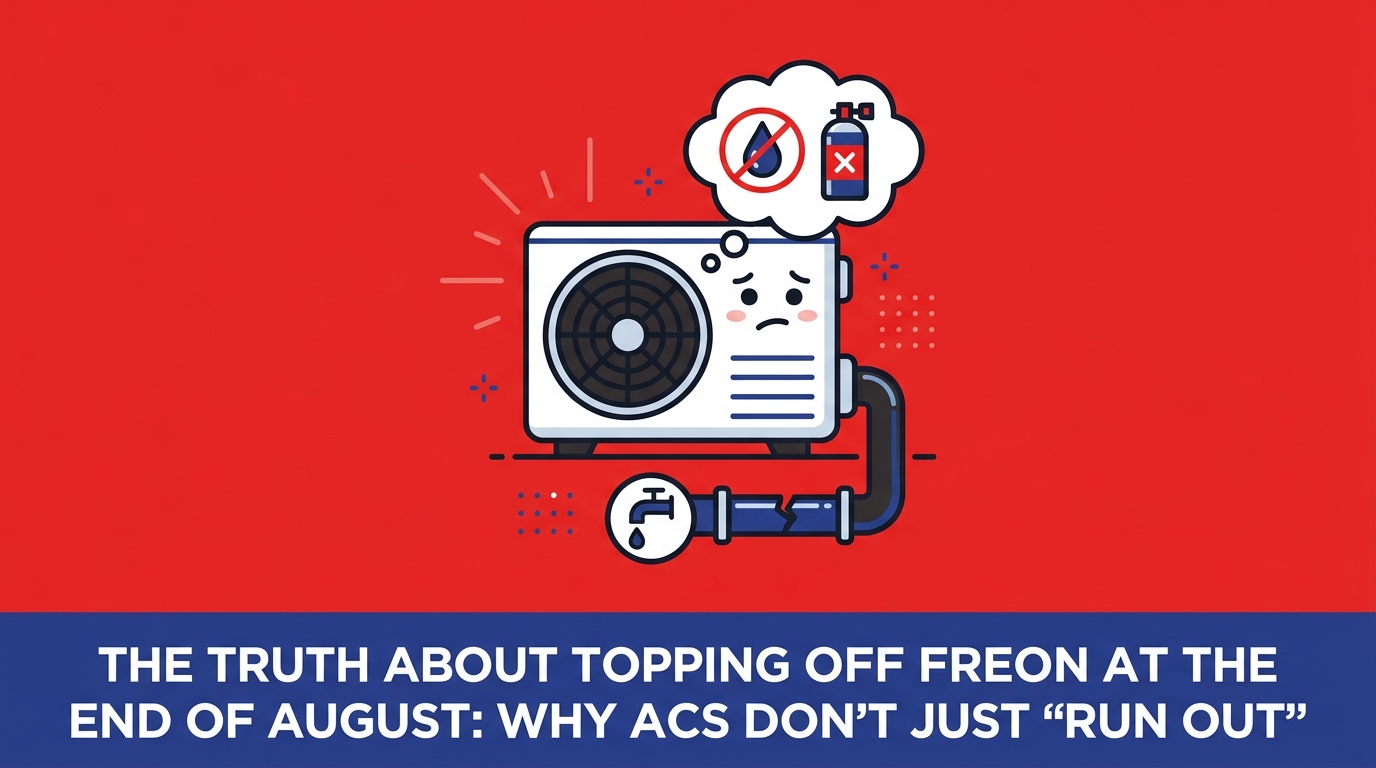
Is your air conditioner running nonstop, yet the house still feels uncomfortably warm? The Truth About Topping Off Freon at the End of August is something every homeowner should know when facing this exact scenario. Right around the late August back-to-school transition, our technicians at Midwest Comfort Heating & Cooling notice a common and frustrating pattern across Des Moines: your cooling system starts to lose its edge right when you need it to cross the seasonal finish line. Many homeowners assume their air conditioner simply worked so hard over the summer that it "burned through" its refrigerant, leading them to request a quick top-off just to get by. However, this assumption masks a much larger mechanical issue that requires more than a temporary fix.
When your system struggles, you need a long-term solution. Whether you are looking for professional HVAC services or specific air conditioning repair and service, understanding the root cause of your cooling loss is the first step toward restoring true comfort to your home.
The Closed-Loop System: Why Your AC Doesn't 'Use Up' Freon
To understand why a top-off is rarely the right answer, it helps to understand how your air conditioner actually handles refrigerant. An air conditioning system operates on a strictly closed loop. The chemical refrigerant—often referred to generally as Freon, regardless of the specific modern blend your unit uses—travels continuously between the indoor evaporator coil and the outdoor condenser unit. Its entire job is to absorb heat from inside your home, carry it outside, and release it into the outdoor air, then return inside to repeat the process.
Refrigerant is Not a Consumable Fuel
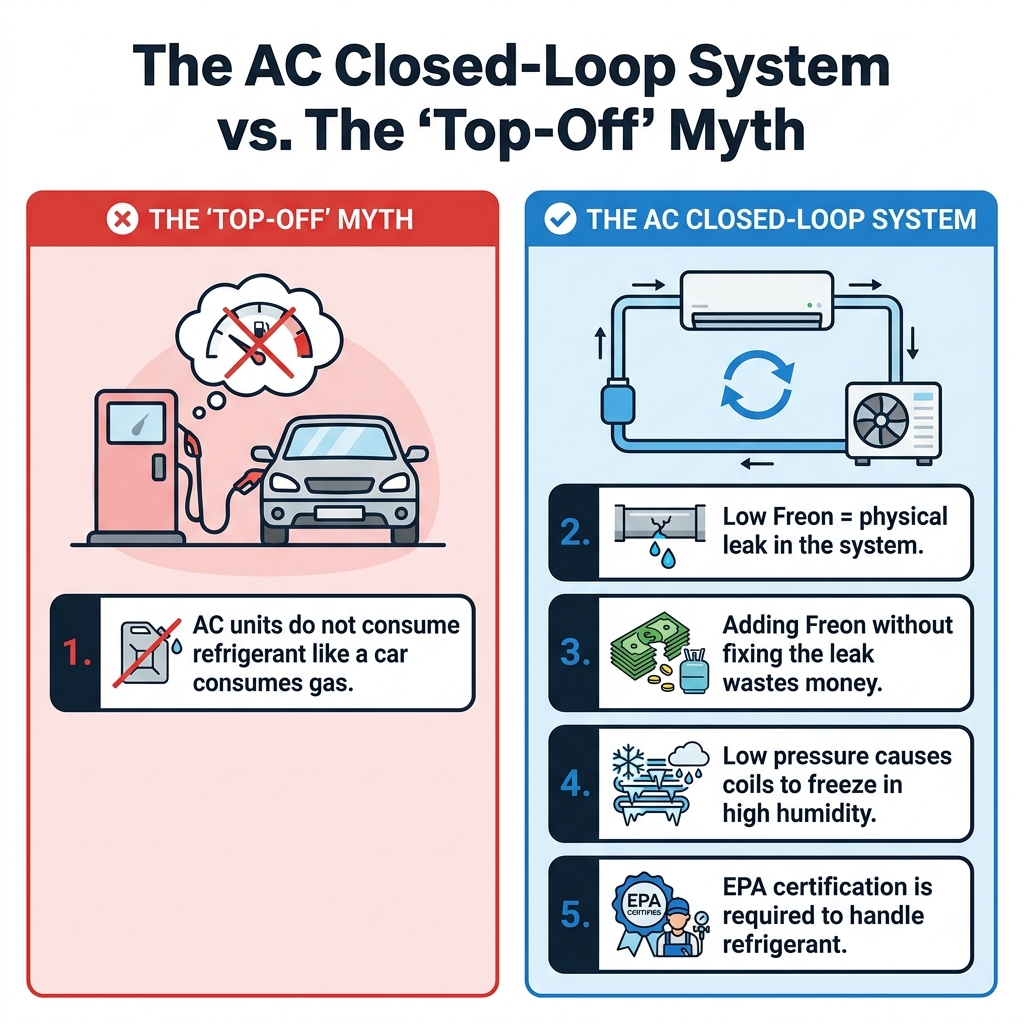
One of the most pervasive myths in home maintenance is that an air conditioner consumes refrigerant the same way a car consumes gasoline. This is completely false. Your system does not burn, exhaust, or use up refrigerant during normal operation. The chemical simply changes states from a liquid to a gas and back again, endlessly circulating through the copper lines. Because the system is hermetically sealed, the exact amount of refrigerant that was put into the unit on the day it was installed should theoretically remain inside the unit for its entire lifespan.
This brings us to an absolute, non-negotiable rule of residential cooling that our team stresses on every service call: if your system is low on Freon, it has a physical leak. A microscopic hole, a failing valve, or a corroded coil has allowed the pressurized gas to escape into the atmosphere. Simply adding more refrigerant without locating and sealing that physical breach is like pouring water into a bucket with a hole in the bottom. You are treating the symptom while completely ignoring the disease.

Why Do Air Conditioners Freeze Up in Late Summer?
One of the most alarming symptoms of low refrigerant is finding a block of solid ice inside your air conditioner or wrapped around the copper lines outside. It seems counterintuitive that a system lacking cooling power would freeze solid, but the physics of a closed-loop system explain exactly why this happens, particularly in our specific regional climate.
The Science of Low Pressure and Freezing Coils
When refrigerant leaks out of the system, the overall pressure inside the copper lines drops significantly. In thermodynamics, pressure and temperature are directly linked. As the pressure of the remaining refrigerant plummets, the temperature of the indoor evaporator coil drops below the freezing point of water. Under normal conditions, this coil should hover around 40 degrees Fahrenheit—cold enough to cool the air, but warm enough to prevent freezing. Once that coil drops below 32 degrees, trouble begins.
This is where the local weather plays a massive role. In our years of keeping Des Moines homes comfortable, we've seen firsthand how persistent late-August high humidity turns a small leak into a major problem. The air inside your home is heavy with moisture. As your indoor fan blows this warm, humid air over the super-cooled evaporator coil, the moisture condenses instantly. Because the coil is below freezing, that condensation turns directly into ice. Within hours, the entire coil can become encased in a solid block of ice, blocking all airflow and causing the system to blow warm air—or no air at all.
Running a frozen system is incredibly dangerous for the equipment. The ice acts as an insulator, preventing the refrigerant from absorbing any heat. This sends cold liquid refrigerant flowing backward into the outdoor compressor, which is only designed to pump gas. This phenomenon, known as liquid slugging, can destroy a compressor in a matter of minutes. If you notice ice forming on your system, turn it off immediately and seek reliable cooling solutions to prevent catastrophic mechanical failure.
The Hidden Dangers of the 'Quick Top-Off' Band-Aid
When faced with a warm house and a struggling AC, the temptation to ask a technician to just "gas it up" so you can limp through the rest of the season is strong. However, this approach carries significant financial, mechanical, and environmental risks.
At Midwest Comfort Heating & Cooling, we focus on honest, transparent diagnostics. We insist on finding and fixing the actual leak rather than applying a temporary, costly band-aid top-off that leaves your system vulnerable. Consider how one local homeowner recently experienced a system issue requiring a replacement part. Because the underlying problem was diagnosed quickly and accurately, our technician was able to return the next day with the exact component needed. The system was repaired permanently and running perfectly in no time, avoiding the cycle of endless, ineffective top-offs.
Why Skipping the Repair is a Costly Mistake
• Wasted financial investment: Refrigerant is expensive. If you pay to add Freon to a leaking system, that new refrigerant will simply leak out again. You will find yourself paying for another service call and more refrigerant in a matter of weeks, or even days, depending on the size of the hole.
• Severe compressor strain: Operating a system with fluctuating, incorrect refrigerant levels forces the compressor to work twice as hard to achieve the same cooling output. The compressor relies on the refrigerant to keep it cool during operation. Without enough Freon, the compressor overheats, leading to acid buildup in the oil and eventual motor burnout.
• Environmental damage: Refrigerants are potent greenhouse gases. Allowing them to continuously vent into the atmosphere through an unrepaired leak is harmful to the environment and violates established best practices for responsible HVAC maintenance.
Signs You Have a Refrigerant Leak (Not Just a Dirty Filter)
Because the symptoms of a refrigerant leak can mimic other common HVAC issues, it is important to know what to look for. A severely clogged air filter can also restrict airflow and cause a system to freeze, so distinguishing between a maintenance oversight and a chemical leak is critical.
If you suspect an issue, reviewing troubleshooting your AC before calling a pro can help you rule out basic problems like thermostat settings or blocked vents. However, in our experience, if you notice the following specific warning signs, you are likely dealing with a breached refrigerant line.
• Airflow Temperature — Dirty Air Filter: Cold, but very weak airflow — Refrigerant Leak: Lukewarm or room-temperature air
• System Sounds — Dirty Air Filter: System sounds strained or louder — Refrigerant Leak: Hissing or bubbling near the indoor unit
• Energy Bills — Dirty Air Filter: Slight increase over time — Refrigerant Leak: Sudden, massive unexplained spikes
• Ice Formation — Dirty Air Filter: Slow buildup on indoor coil only — Refrigerant Leak: Rapid freezing on indoor coil and outdoor line
• Cooling Cycles — Dirty Air Filter: Longer cycles to reach set temp — Refrigerant Leak: Running constantly without ever reaching set temp
Hissing or bubbling sounds: If you hear a distinct hiss coming from the indoor unit or the outdoor copper lines, you are hearing pressurized gas escaping. If the leak is occurring where condensation has pooled, it may sound like a faint bubbling noise.
Vents blowing lukewarm air: If your thermostat is set to 70 degrees but the air coming from your registers feels like a room-temperature fan, the system has lost its ability to transfer heat due to low refrigerant volume.
Unexplained spikes in energy bills: Because the system cannot satisfy the thermostat, it will run continuously. This non-stop operation draws massive amounts of electricity, resulting in a shocking utility bill at the end of the month.
What Professional Leak Detection and Repair Looks Like
Fixing a refrigerant leak is a highly technical process that requires specialized training, heavy equipment, and strict adherence to federal law. It is never a do-it-yourself project. Handling and recovering refrigerant requires mandatory EPA Section 608 certification, as improper handling is dangerous and illegal.
When our Midwest Comfort Heating & Cooling technicians arrive to address a failing air conditioner, our response is swift and methodical. For example, when one of our Des Moines customers lost AC on the hottest day of the summer, our certified technician arrived by late morning, properly diagnosed the pressure issue, and had the system working correctly within an hour. Here is exactly what our professional process entails:
1. Electronic Leak Detection: Technicians use highly sensitive electronic "sniffers" that detect the specific chemical signature of refrigerant gas in the air. By running this wand along the copper lines, coils, and weld joints, they can pinpoint microscopic holes that are invisible to the naked eye.
2. UV Dye Inspection: In cases where a micro-leak is difficult to isolate, a technician may inject a specialized, system-safe ultraviolet dye into the lines. After the system runs for a short period, the technician uses a UV flashlight to illuminate exactly where the dye (and the refrigerant) is escaping.
3. Safe Refrigerant Recovery: Before any repair can be made, all remaining refrigerant must be safely pumped out of the system and stored in a specialized recovery cylinder. It is illegal to vent this gas into the air.
4. Sealing the Breach: Depending on the location of the leak, the technician will either braze (weld) the hole shut, replace the failing valve, or, if the evaporator coil is severely corroded, recommend replacing the coil entirely.
5. Vacuum and Recharge: Once the repair is made, a vacuum pump is attached to remove all air and moisture from the lines. Finally, the system is recharged with the precise weight of new refrigerant specified by the manufacturer, ensuring factory-perfect operation.
Preparing Your System for the Rest of the Season
As summer winds down, your air conditioner has already logged hundreds of hours of grueling operation. This peak cumulative wear is exactly why our team sees so many micro-leaks suddenly become symptomatic in late August. The constant vibration, thermal expansion, and contraction over the hot months eventually cause weak weld joints to give way or corroded copper to finally breach.
The best way to prevent these end-of-season breakdowns is through proactive care. Having a professional assess the overall health of your system after heavy usage ensures that minor wear and tear does not escalate into a catastrophic compressor failure. Regular check-ups allow technicians to monitor refrigerant pressure, inspect electrical contacts, and clear away debris that forces the system to work harder than necessary.
Ongoing maintenance is the key to preventing unexpected failures during extreme heat. By investing in a routine AC maintenance plan, you ensure that your system is always operating at peak efficiency, keeping your energy bills low and extending the overall lifespan of the equipment.
Frequently Asked Questions About AC Refrigerant
Does an AC use up Freon over the summer?
No, air conditioners operate on a closed loop and do not consume refrigerant. The chemical is never burned off like fuel in a car. If your system's refrigerant levels are low, it means there is a physical leak somewhere in the copper lines or coils that must be repaired.
Why is my AC freezing up in August?
Low refrigerant drops the pressure inside your system, which causes the indoor evaporator coils to drop below freezing. When the high late-summer humidity in the air hits these super-cooled coils, the condensation instantly turns into solid ice, blocking airflow entirely.
Is it normal to add refrigerant to an AC?
It is never normal to add refrigerant to a healthy, properly functioning air conditioning system. Adding refrigerant is only necessary after a leak has been professionally located, sealed, and the system has been tested to ensure it can hold pressure.
Can I just add Freon to my AC myself?
No, handling, purchasing, and recovering refrigerant requires mandatory EPA Section 608 certification. Improper handling is not only illegal and harmful to the environment, but adding the wrong amount of refrigerant can permanently destroy your compressor.
How do professionals find a Freon leak in a home AC?
Technicians use specialized electronic leak detectors, ultrasonic tools, or fluorescent UV dye injected into the system. These advanced diagnostic methods allow them to pinpoint microscopic holes in the copper lines or coils that cannot be seen with the naked eye.
What happens if I ignore a low refrigerant warning?
If you ignore a leak, the system will run constantly in a futile attempt to cool the house, driving up your energy bills significantly. Eventually, the lack of refrigerant will cause the compressor to overheat and fail, leading to a massive, expensive system replacement.
Don't Settle for a Summer Band-Aid—Get a Permanent Fix
When your home is uncomfortably warm and the back-to-school season is already adding stress to your schedule, a quick top-off might seem like the easiest path forward. However, paying for new refrigerant without sealing the underlying leak is a wasted investment that puts your entire cooling system at risk. The quick fix is never the right fix when it comes to a closed-loop system.
Instead of crossing your fingers and hoping a band-aid solution holds until autumn, encourage the long-term health of your equipment by scheduling a proper diagnostic. A thorough, professional assessment will identify the exact location of the leak, allowing for a permanent repair that restores your comfort, protects your compressor, and lowers your monthly energy bills. Reach out to our experts at Midwest Comfort Heating & Cooling today to ensure your system is safe, efficient, and ready to handle whatever the rest of the season brings.
Customer Testimonials
Service Areas
