



Is a Heating and Cooling Special Worth the Cost When Your AC is Already Struggling?
Why a Struggling Air Conditioner Requires More Than a Standard Tune-Up
Are you wondering, is a heating and cooling special worth the cost when your AC is already struggling? It is a common question when you are dealing with high indoor temperatures despite the AC running continuously. You hear the blower motor running, you feel a weak breeze from the vents, but your thermostat simply refuses to drop. In moments of frustration, it is tempting to look for a quick, inexpensive fix. You might see an advertisement for a seasonal maintenance special and hope that a quick cleaning will magically restore your system's cooling power.
Here is the thing: preventative maintenance specials are designed specifically for healthy, fully functioning systems. They are routine check-ups meant to keep a good system running efficiently. At Midwest Comfort Heating & Cooling, our technicians frequently respond to calls where a homeowner hoped a routine checklist would fix an actively failing unit. When your equipment is failing to cool your home, you do not need a routine checklist—you need targeted troubleshooting. Booking a standard maintenance special for a broken unit is like taking your car in for an oil change when the transmission is slipping. It completely misses the root cause of the problem.
If your system is actively failing and you need immediate help, it is crucial to seek out dedicated air conditioning services rather than relying on a basic check-up. The critical distinction comes down to intent. A maintenance visit verifies that clean, working parts are ready for the season. A diagnostic visit actively hunts down electrical failures, pressure imbalances, and mechanical faults.
Booking the wrong service wastes valuable time, especially when you are battling July peak summer heat and humidity in Iowa. When indoor temperatures are rising rapidly, every hour counts. A technician arriving to perform a basic tune-up will not have the time block scheduled to tear down your system, trace a complex electrical short, or pinpoint a microscopic refrigerant leak. Setting the right expectation from the start ensures that a proper evaluation will uncover the actual root cause, getting your home comfortable again as quickly as possible.
The Fundamental Difference Between Preventative Maintenance and Diagnostic Services
To understand why a struggling system needs a different approach, you have to look at the specific procedural differences between a routine checklist and active troubleshooting. A preventative maintenance checklist focuses on cleaning, visual inspections, and verifying that the system is operating within normal parameters. It is an essential service for extending the lifespan of your equipment, but it is not a repair procedure.
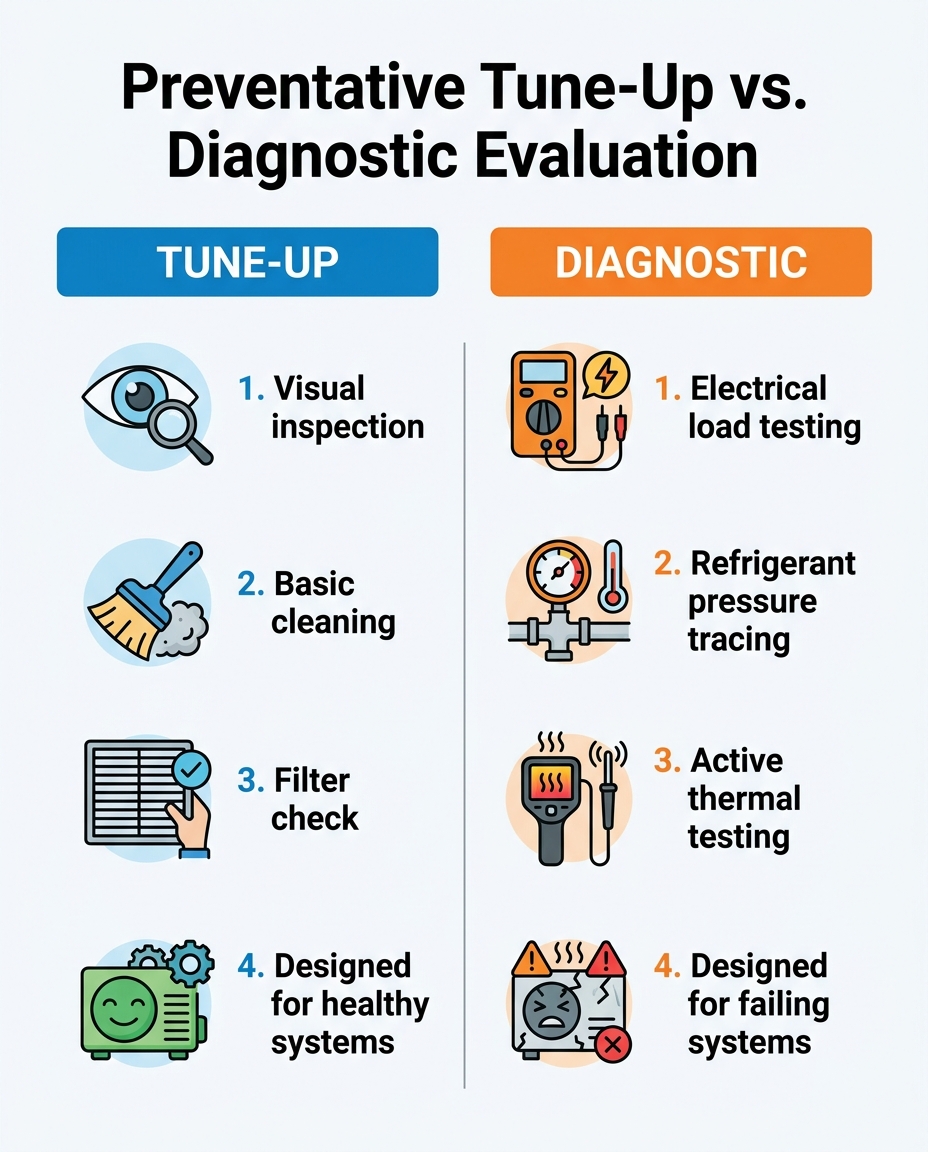
If you want to know what a proper AC tune-up actually includes, it generally involves washing the outdoor condenser coil, clearing the condensate drain line, checking the air filter, and visually inspecting the electrical contactors for obvious signs of wear. These steps keep a healthy system healthy.
However, standard specials do not include the advanced electrical component load testing or refrigerant leak tracing required when a system is failing. Diagnostics require specialized tools that go far beyond a basic visual check. Our diagnostic technicians use digital manifold gauges and psychrometers to measure superheat (the temperature of the refrigerant vapor above its boiling point) and subcooling (the temperature of liquid refrigerant below its condensing point). We use multimeters to measure the exact microfarad readings of your capacitors and the amp draw of your compressor under active thermal load. Applying a preventative checklist to a failing system is like putting a bandage on a mechanical fracture—it simply does not address the underlying physics of the failure.
What a Standard Maintenance Special Covers
• Visual inspections: Technicians look at belts, fan motors, and wiring to ensure nothing is obviously broken, frayed, or disconnected.
• Basic cleaning: This includes clearing debris from the outdoor unit and washing the accessible portions of the condenser coil to promote good airflow.
• Verification of operation: The technician will cycle the thermostat to ensure the system turns on and off correctly, assuming the system is already healthy.
What a Legitimate Diagnostic Evaluation Requires
• Electrical load testing: Pinpointing exact voltage drops, testing capacitor health under load, and measuring the amp draw to identify compressor stress.
• Refrigerant pressure tracing: Using advanced gauges to find the exact locations of pressure imbalances, which indicates leaks or metering device failures.
• Active thermal testing: Testing system performance under an active thermal load to see exactly how the equipment behaves when forced to cool a hot house.
• Primary Goal — Preventative Maintenance Special: Keep a healthy system running efficiently — Diagnostic Evaluation: Identify the root cause of a system failure
• System Status — Preventative Maintenance Special: Unit is currently cooling the home properly — Diagnostic Evaluation: Unit is struggling or completely broken
• Tools Used — Preventative Maintenance Special: Hose, coil cleaner, basic multi-meter — Diagnostic Evaluation: Manifold gauges, psychrometers, leak detectors
• Time Required — Preventative Maintenance Special: Generally completed in a predictable timeframe — Diagnostic Evaluation: Varies based on the complexity of the issue
• End Result — Preventative Maintenance Special: A clean, optimized air conditioner — Diagnostic Evaluation: A detailed repair plan and health report

The Hidden Risks of Delaying Proper Diagnostics During Peak Heat
When your home is suffering from high indoor temperatures despite the AC running continuously, time is not on your side. Ignoring a struggling system and hoping a cheap maintenance visit will fix it introduces severe mechanical risks. An air conditioner that runs non-stop without properly cooling the home places immense strain on the compressor. The compressor is the heart of your HVAC system, and it relies on cool refrigerant returning from the house to keep its internal motor from overheating.
In our years of repairing air conditioners across the Des Moines metro, we have seen firsthand how the intense July heat and high humidity rapidly accelerate wear on a struggling AC, making delays particularly risky. When a system runs continuously in extreme heat without satisfying the thermostat, the compressor operates outside of its safe design limits. This can lead to thermal overload, where the compressor shuts itself down to prevent melting its internal windings. If this cycle repeats too many times, the compressor will fail permanently.
Furthermore, ignoring underlying airflow or refrigerant issues can cause the indoor evaporator coil to freeze entirely. When refrigerant levels are low, or airflow is restricted by a clogged filter or failing blower motor, the temperature of the indoor coil drops below freezing. The high humidity in the air condenses on the freezing coil and immediately turns to ice. Eventually, this ice block restricts all airflow, and the system starts sending liquid refrigerant back down the suction line to the compressor—a destructive process known as liquid slugging.
Booking a superficial tune-up acts as a dangerous delay tactic. By the time a maintenance technician arrives, realizes the system is broken, and reschedules you for a diagnostic visit, a minor issue could have escalated into a catastrophic failure. Fast, accurate troubleshooting is essential when extreme weather hits.
1. The system runs continuously: The thermostat calls for cooling, but mechanical issues prevent the system from removing heat.
2. Component stress multiplies: The compressor overheats, and electrical components like capacitors and contactors degrade rapidly from non-stop operation.
3. Secondary failures occur: Coils freeze, blower motors burn out, or compressors suffer permanent mechanical damage from liquid slugging.
4. Complete system shutdown: The air conditioner fails entirely, leaving your home completely without cooling during the hottest part of the year.
One local homeowner recently reached out to our dispatch team on the hottest day of the summer when their AC went out completely. Because they requested a targeted diagnostic rather than a basic check-up, one of our expert technicians arrived by 11:30 a.m. and had the system actively cooling again within an hour. Getting the right service immediately prevents minor hiccups from becoming major emergencies.
Recognizing the Limitations of Heavily Discounted HVAC Specials
It is incredibly common to see advertisements for heavily discounted HVAC specials, especially as the summer heat sets in. While these offers can seem like a lifeline when you are dealing with high indoor temperatures despite the AC running continuously, it is vital to understand their limitations. These heavily discounted specials are often structured as loss-leaders. A loss-leader is a marketing strategy designed to get a technician in the door to perform routine checks on a healthy system, with the hope of building a long-term relationship or identifying minor preventative upgrades.
The problem arises when homeowners attempt to use these routine specials to fix an actively failing system. These specials explicitly exclude the diagnostic labor required to legally and safely repair a broken unit. Diagnostic labor requires a highly trained technician to spend significant time isolating electrical shorts, calculating airflow dynamics, and tracing microscopic refrigerant leaks. This level of intensive troubleshooting is simply not covered under a basic promotional cleaning.
There is nothing more frustrating than paying for a special only to have the technician arrive, look at the frozen coil or dead compressor, and inform you that a separate diagnostic fee is still required before any actual troubleshooting can begin. This bait-and-switch feeling is entirely avoidable if you book the correct service from the start.
As a dedicated local HVAC provider, Midwest Comfort Heating & Cooling is committed to providing honest, comprehensive diagnostic evaluations over fly-by-night cheap specials. Genuine promotions absolutely exist for healthy systems, and you should always take advantage of legitimate heating and cooling promotions when scheduling your annual maintenance. However, when your system is already struggling, transparency and thorough troubleshooting are the only ways to restore your home's comfort reliably.
What to Expect During a Comprehensive Diagnostic Evaluation
Demystifying the diagnostic process helps you feel confident that you are booking the correct service for your home. When you schedule a diagnostic evaluation, you are paying for the technician's expertise, their advanced diagnostic tools, and the dedicated time required to isolate the exact root cause of your system's failure. You are not just getting a quick visual once-over; you are getting a deep dive into the mechanical and electrical health of your equipment.
The process begins at the thermostat to verify that the control signals are being sent correctly. From there, the technician moves to the indoor unit to measure airflow, static pressure, and blower motor performance. Next, they evaluate the outdoor condenser, testing the electrical load on the compressor, checking the capacitance of the start and run capacitors, and measuring the exact pressures and temperatures of your refrigerant cycle. This step-by-step process ensures that no stone is left unturned.
Just last summer, our team helped a Des Moines customer who experienced a sudden system failure during peak summer load. By booking a precise diagnostic evaluation with us, a technician arrived in under two hours, quickly isolated the failed component, and had the air conditioner back on in less than an hour. That is the power of targeted troubleshooting.
Once the evaluation is complete, you receive a detailed, transparent report on the system's health and the required repairs. This report explains exactly what failed, why it failed, and what options you have to fix it. Proper diagnostics actually save you money in the long run by preventing recurring breakdowns. Instead of repeatedly paying for cheap band-aids that fail a week later, you fix the core issue once.
If you want to avoid these sudden breakdowns entirely in the future, enrolling in a comprehensive HVAC maintenance plan ensures your system gets the preventative care it needs before the extreme weather hits. When you are facing July peak summer heat and humidity in Iowa, the peace of mind that comes from knowing the exact status of your cooling system is invaluable.
Frequently Asked Questions About AC Specials and Diagnostics
What is the difference between an AC tune-up and a diagnostic?
A tune-up is a preventative maintenance checklist designed specifically for a functioning, healthy system. It involves cleaning coils, clearing drains, and visually inspecting components to ensure they are ready for the season. A diagnostic, on the other hand, is a targeted troubleshooting procedure used to identify exactly why a system is failing. Diagnostics involve advanced electrical load testing and refrigerant pressure measurements to isolate broken components.
Will a maintenance special fix my struggling AC?
No, maintenance specials do not include the labor or advanced testing required to fix broken components. These specials are priced and scheduled strictly for routine cleaning and visual checks. Booking a maintenance special for a broken air conditioner often just delays the necessary repair, leaving you hot and frustrated while you wait for a proper diagnostic visit to be rescheduled.
Can an AC tune-up fix a broken air conditioner?
Tune-ups are strictly for cleaning and verifying operations, not for repairing broken parts or diagnosing complex mechanical failures. If your compressor is failing, your refrigerant is leaking, or your blower motor is dead, washing the outdoor coil will not solve the problem. Attempting to tune up a broken system will not restore its cooling capacity; it requires a dedicated repair procedure.
Why is my AC running but not cooling the house?
When you experience high indoor temperatures despite the AC running continuously, it indicates a significant mechanical failure. Common culprits include a refrigerant leak, a completely frozen indoor evaporator coil, or a failing compressor that can no longer pump refrigerant effectively. This specific symptom requires a thorough diagnostic evaluation to test the pressures and electrical loads, not a routine cleaning.
How long does a proper AC diagnostic take?
Diagnostics typically take longer than a basic visual inspection because they involve actively testing electrical loads, tracing circuitry, and measuring refrigerant pressures under load. The exact time varies depending on the complexity of the underlying issue. While a simple blown capacitor might be diagnosed in twenty minutes, tracing an intermittent electrical short or finding a microscopic refrigerant leak can take well over an hour of dedicated troubleshooting.
Get the Right Answers for Your Struggling Air Conditioner Today
When the temperature inside your home is rising and your air conditioner cannot keep up, skipping the diagnostic step only prolongs your discomfort. It is easy to be tempted by a discounted tune-up, but applying a preventative checklist to an actively failing system is a recipe for wasted time and escalating mechanical damage. Especially when dealing with July peak summer heat and humidity in Iowa, your equipment needs precise, targeted troubleshooting.
A clear, no-nonsense diagnostic evaluation is the fastest, most reliable path to restored cooling. By allowing a professional to isolate the exact cause of the failure through electrical and thermal testing, you eliminate the guesswork. Do not settle for a superficial check when your comfort is on the line. Schedule an expert diagnostic today to solve the problem accurately the first time, ensuring your home stays cool and comfortable no matter how hot it gets outside.
Customer Testimonials
Service Areas
