



Comparing Standard vs High-Recovery Water Heaters for Large Iowa Families
Are Cold Showers Disrupting Your Morning Routine?
Is your household constantly running out of hot water right when you need it most? Here at Midwest Comfort Heating & Cooling, we notice that comparing standard vs high-recovery water heaters for large Iowa families is a decision that usually comes to a head during the late-summer transition. When the August back-to-school morning rush hits, household routines suddenly condense. Instead of staggered showers throughout the day, you have multiple family members needing to shower, get dressed, and eat breakfast within a tight one-to-two-hour window. A pattern we see often is that this sudden spike in demand pushes older or undersized water heating systems past their breaking point, leaving the last person in line shivering under a stream of cold water.
If you are navigating this daily frustration, evaluating your water heaters and considering a professional water heater replacement in Des Moines might be the next logical step. The choice between replacing a failing tank with a standard model or upgrading to a high-recovery unit comes down to understanding your family's exact usage patterns. By letting our experts look at how these systems actually generate and store hot water, you can make a confident choice that eliminates the morning cold-shower lottery once and for all.
The Mechanics of Hot Water: Understanding Recovery Rates and FHR
Before you can accurately compare different types of water heaters, you need to understand the metrics that dictate how long your showers can last. Many homeowners assume that tank capacity—whether a tank holds 40 or 50 gallons—is the only number that matters. In reality, our technicians know that the speed at which the system heats new water is far more important for busy households.
When our team evaluates how well a system will perform under pressure, we look at two primary metrics. Here is how they break down:
1. Recovery Rate (Gallons Per Hour): This is the exact number of gallons a water heater can heat to the designated set temperature (usually 120 degrees Fahrenheit) in one hour. A higher recovery rate means the tank rebounds faster after being depleted.
2. First Hour Rating (FHR): This is a standardized calculation that combines the tank's total stored capacity with its one-hour recovery rate. The FHR tells you exactly how much hot water the system can deliver during your busiest hour of the day.
3. BTU Input and Burner Size: In gas-powered units, British Thermal Units (BTUs) measure the amount of heat energy the burner produces. A larger burner with a higher BTU input drives a faster recovery rate, allowing the system to heat incoming cold water much quicker.
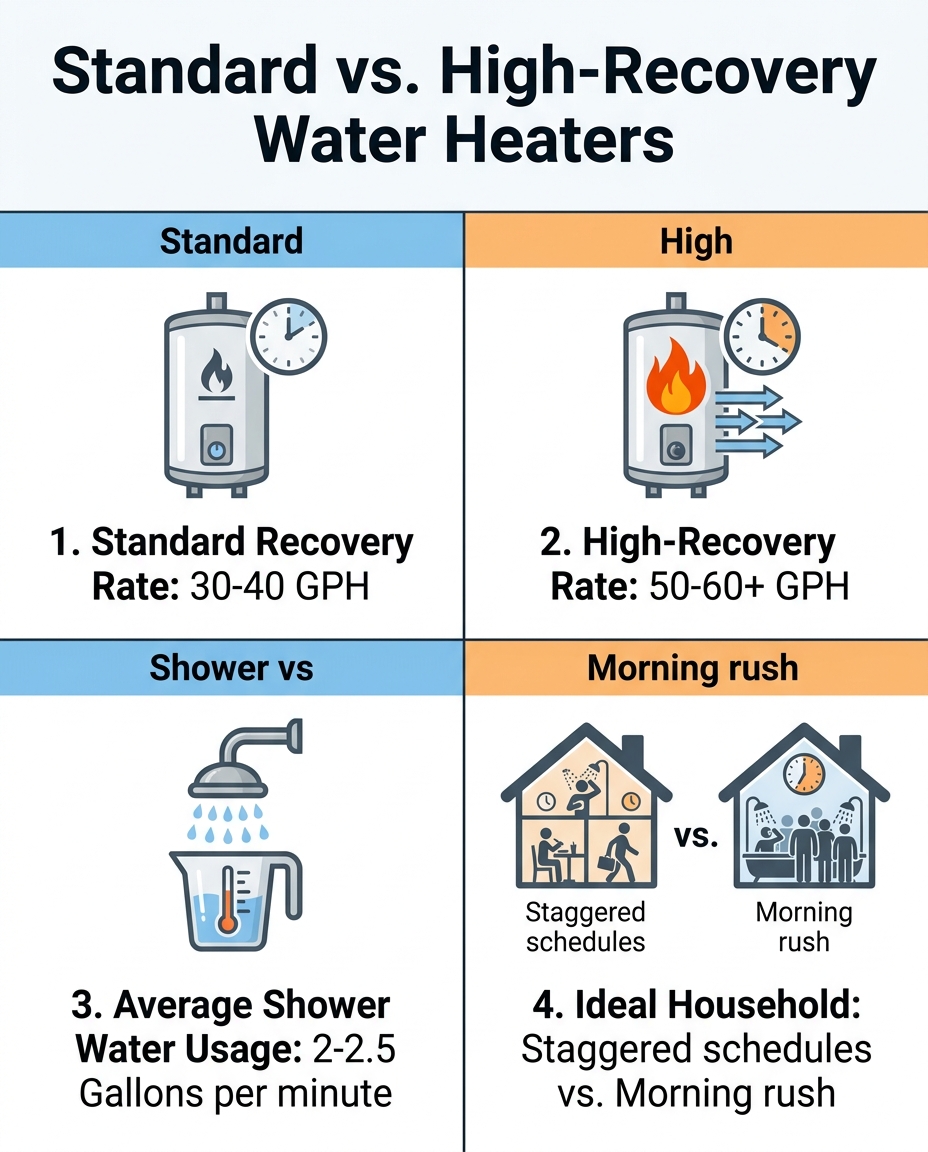
To put these numbers into perspective, a standard showerhead uses roughly 2 to 2.5 gallons of water per minute. A typical 15-minute shower consumes up to 37.5 gallons of hot water. If two family members take back-to-back showers, the household demands up to 75 gallons of hot water in just thirty minutes. If your system's First Hour Rating cannot meet that demand, the tank will run out of hot water before the second shower ends. If you are currently choosing between gas and electric water heaters, our installers always advise paying close attention to the FHR and recovery rate differences between the two fuel types.
Standard Water Heaters: Reliable but Limited for Peak Demand
Standard water heaters are the most common systems found in residential homes. They rely on proven, traditional technology to maintain a steady reservoir of hot water. For a typical standard gas water heater, you can expect a recovery rate hovering around 30 to 40 gallons per hour (GPH). This means that if you completely drain a 40-gallon tank, it will take at least an hour for the system to fully heat a fresh batch of water.
In our years of servicing homes across central Iowa, we have found that these units are highly effective under the right conditions, but they have distinct operational limits when pushed too hard.
• Pro: Proven and straightforward technology. Standard tanks have been used for decades, making them widely available and easy for our team to service.
• Pro: Lower initial equipment cost. Because they use standard-sized burners and traditional venting, the upfront investment is generally lower than advanced models.
• Pro: Excellent for staggered schedules. If your household runs the dishwasher at night, does laundry in the afternoon, and spaces out showers, a standard unit performs perfectly.
• Con: Struggles during peak usage. A 30-40 GPH recovery rate simply cannot keep up with simultaneous hot water draws, leading to long wait times between showers.
• Con: Vulnerable to overwork. Constantly draining the tank and forcing the burner to run continuously can accelerate wear and tear on the system.
The ideal use case for a standard water heater is a smaller family or a household with highly varied schedules. If your appliances run at different times of the day and no one is fighting for bathroom time in the morning, a standard unit is likely sufficient. However, if you are constantly pushing your current standard tank beyond its limits and facing frequent breakdowns, scheduling a water heater repair might only be a temporary fix for an undersized system.
• Average Recovery Rate — Standard Water Heater: 30 - 40 Gallons Per Hour — Impact on Daily Routine: Requires 45-60 minutes between heavy usage periods.
• Burner Size (BTU) — Standard Water Heater: Standard (approx. 35,000 - 40,000) — Impact on Daily Routine: Heats water at a steady, moderate pace.
• Ideal Household Routine — Standard Water Heater: Staggered showers, spaced-out laundry — Impact on Daily Routine: Perfect for homes with flexible morning schedules.
• Simultaneous Usage — Standard Water Heater: Poor — Impact on Daily Routine: Cannot support a shower and a washing machine running at once.
High-Recovery Water Heaters: Built for the Morning Rush
High-recovery water heaters are specifically engineered to solve the problem of condensed hot water demand. Instead of relying solely on a massive storage tank, these units focus on speed. By utilizing larger burners and significantly higher BTU inputs, high-recovery models can push their recovery rates to 50, 60, or even 70+ gallons per hour.
We consistently see how this rapid rebound capability completely changes how a large family manages their morning routine.
• Pro: Rapid rebound times. With a recovery rate exceeding 50 GPH, the tank heats new water almost as fast as it is being drawn out, virtually eliminating the wait time between showers.
• Pro: Supports simultaneous draws. You can run the dishwasher and take a hot shower at the same time without experiencing a sudden drop in water temperature.
• Pro: Smaller physical footprint. Instead of trying to squeeze a massive 80-gallon standard tank into a small utility closet, a 50-gallon high-recovery unit provides the same (or better) First Hour Rating while taking up less floor space.
• Con: Higher upfront investment. The advanced burners and upgraded components require a larger initial commitment compared to standard models. (Note: Generic local utility rebates may apply to qualifying high-efficiency installations, so we always advise homeowners to verify current programs to help offset costs).
• Con: Potential for higher peak energy draw. Because the burners are larger, they consume fuel at a faster rate while actively heating, though they run for shorter durations.
Our team frequently recommends high-recovery units for large families living in the Des Moines suburbs who are trying to get three or four people showered, dressed, and out the door at the exact same time. The faster recovery rate provides a continuous buffer, ensuring that the last shower of the morning is just as hot as the first. If you recognize this pattern in your own home, looking into a professional water heater installation in Waukee or the surrounding suburbs can permanently resolve your morning bottlenecks.

The Iowa Climate Factor: How Cold Groundwater Changes the Math
When comparing water heaters, it is easy to get caught up in factory specifications and laboratory testing numbers. However, our installation crews know that to understand how a system will actually perform in your home, you have to account for regional climate realities. In Iowa, the temperature of the incoming municipal or well water plays a massive role in your water heater's real-world performance.
The technical term for this is Delta T (temperature rise). Delta T represents the difference between the temperature of the cold groundwater entering your home and the target output temperature of your water heater, which is typically set to 120 degrees Fahrenheit.
During the warmer late-summer months, incoming groundwater in Iowa might sit around 60 degrees. To reach 120 degrees, the water heater only needs to achieve a 60-degree temperature rise. However, as we look ahead to harsh Iowa winters, incoming groundwater temperatures can plummet to 40 degrees or lower. Suddenly, the water heater must achieve an 80-degree temperature rise just to provide the same level of comfort.
This larger required temperature rise forces the water heater's burner to work significantly harder and longer. Because the water is so much colder when it enters the tank, it takes more energy and more time to heat it. This effectively lowers the real-world recovery rate of the system during the winter months. A standard tank that provides adequate hot water for back-to-school routines in August might suddenly leave you shivering in January because its recovery rate drops under the strain of freezing groundwater.
In our experience, high-recovery units provide a necessary buffer against these seasonal performance drops. Because they start with a much higher BTU input and a faster baseline recovery rate, they can absorb the impact of a larger Delta T without completely failing to meet your household's morning demand. The extra heating power ensures that even when the incoming water is ice-cold, the tank can still rebound fast enough to keep your showers warm.
Sizing Your System: Why Bigger Isn't Always Better
A common misconception we hear from homeowners is that the only way to get more hot water is to buy a much larger tank. If a 40-gallon tank isn't enough, the instinct is to upgrade to a massive 75- or 80-gallon standard unit. While this does increase your total storage capacity, our team rarely finds this to be the most efficient or effective way to solve a peak demand problem.
Oversized tanks waste a significant amount of energy through a process called standby heat loss. When you have an 80-gallon tank sitting in your basement, the system must constantly burn fuel to keep all 80 gallons heated to 120 degrees, 24 hours a day, seven days a week. If your family only experiences high demand for two hours during the morning rush, you are paying to heat dozens of gallons of unused water for the remaining 22 hours of the day. Furthermore, massive tanks take up a huge amount of physical space, often requiring expensive modifications to your utility room just to make them fit.
A properly sized high-recovery unit solves this problem by focusing on generation speed rather than bulk storage. We often show customers how a 50-gallon high-recovery unit can easily match the First Hour Rating of an 80-gallon standard tank. It meets your peak demand without oversizing the physical footprint and without wasting excessive energy on standby heat loss.
This is where our professional insight becomes invaluable. At Midwest Comfort Heating & Cooling, our team utilizes a customized approach to properly sizing water heating systems. Instead of simply guessing or selling you the biggest tank available, our sizing process involves calculating your exact household demand, factoring in local water conditions, and matching those metrics to the correct BTU input. This customized approach prevents both cold showers and unnecessary energy waste, ensuring you get a system engineered for your specific lifestyle.
Frequently Asked Questions About Water Heater Upgrades
Is a high recovery water heater worth it for a large family?
Yes, in our experience, a high-recovery unit is generally worth the investment for large households. If your family takes back-to-back showers or runs multiple hot water appliances simultaneously, a standard tank will frequently run out of hot water. The faster rebound time of a high-recovery model eliminates the wait time between showers, ensuring everyone has access to hot water during the busiest parts of the day.
How does cold weather affect water heater recovery time?
Cold weather lowers the temperature of incoming groundwater, directly slowing down the recovery process. When the water entering the tank is significantly colder, the water heater must expend more energy and time to raise it to the standard 120-degree output. This larger temperature rise forces the system to work harder, which can noticeably reduce the effective recovery rate during the winter months.
What is the difference between a standard and high recovery water heater?
The primary difference lies in the burner size and the BTU input. A standard gas water heater typically features a smaller burner that provides a steady recovery rate of 30 to 40 gallons per hour. A high-recovery unit utilizes a larger burner with a higher BTU input, allowing it to heat water much faster—often exceeding 50 to 60 gallons per hour—which drastically reduces the wait time for hot water.
What is a good recovery rate for a water heater?
A good recovery rate depends entirely on your specific household size and daily routine. For smaller homes with staggered schedules, our technicians find a standard rate of 30 to 40 GPH is perfectly adequate. However, for homes with four or more people who need to shower around the same time, we recommend a recovery rate of 50 GPH or higher to prevent the tank from running cold.
Can I just install a larger standard tank instead?
While possible, installing a larger standard tank is often less efficient than upgrading to a high-recovery model. Larger tanks take up significantly more physical space in your utility room and consume more standby energy by constantly heating water you aren't actively using. A high-recovery unit provides the same volume of hot water during peak times without the wasted energy and massive footprint of an oversized tank.
Make Confident Upgrades with a Local Expert
Understanding the difference between standard and high-recovery water heaters empowers you to make a confident decision about your home's comfort. By looking past simple tank size and focusing on First Hour Ratings and recovery rates, you can accurately match a new system to your family's exact morning routine. You no longer have to guess whether a new unit will hold up to the back-to-school morning rush.
Because local groundwater temperatures and specific household demands vary so widely, professional sizing by our team is the best way to guarantee optimal performance. Do not settle for another year of shivering through the last shower of the morning. Schedule a professional inspection with Midwest Comfort Heating & Cooling to evaluate your current system's capabilities, discuss your specific peak demand challenges, and explore the best replacement options for your home. A clear, scenario-based comparison of your options ensures you get a system that finally keeps up with your life.
Customer Testimonials
Service Areas
