



How Des Moines' Late Summer Dust Impacts Your HVAC Filter Lifespan
Why Late Summer Air Quality in Central Iowa Challenges Standard HVAC Advice
According to the Department of Energy, replacing a dirty, clogged filter with a clean one can lower your air conditioner's energy consumption by 5% to 15%. While that statistic holds true anywhere in the country, understanding exactly how Des Moines' late summer dust impacts your HVAC filter lifespan is crucial for local homeowners. Lingering August heat creates peak demand for your AC right as the air quality drops, creating a perfect storm for system strain. At Midwest Comfort Heating & Cooling, we consistently see standard 90-day filter replacement guidelines fail completely against central Iowa's seasonal agricultural dust. If you want to keep your cooling system running smoothly through the end of the season, our team recommends proactively rethinking your maintenance and indoor air quality strategies before the system fails.
To protect your system, explore our indoor air quality solutions or sign up for a comprehensive HVAC maintenance plan today.
The 90-Day Myth in the Midwest
When you purchase a standard pleated air filter at a big-box store, the packaging typically recommends replacing it every three months. This advice is written for a generic, average household in a mild, urban environment. It assumes a predictable baseline of indoor dust, pet dander, and standard airborne particles.
However, Des Moines and central Iowa do not fit this generic profile, especially as summer draws to a close. The environmental load placed on your HVAC system multiplies exponentially during the August and late summer agricultural transition. Relying on a standardized three-month schedule during this specific time of year leaves your air conditioner highly vulnerable to restricted airflow, mechanical strain, and premature breakdowns.
The Unique Anatomy of Central Iowa's August Air
As the peak summer humidity begins to break, central Iowa transitions into a drier climate profile. The dry late-summer Midwest soil becomes highly susceptible to being picked up by the wind. Simultaneously, the onset of harvest season activities kicks agricultural runoff and field dust into high gear. The wind carries this heavy agricultural dust directly into residential neighborhoods, where it is pulled straight into your home's HVAC intake zones.
During this window, local air quality monitors consistently register a sharp increase in airborne particulate matter, specifically PM10 (coarse particles) and PM2.5 (fine particles). Unlike standard urban smog, these particles are heavy, dense, and incredibly effective at blinding filter media. When your air conditioner runs non-stop to combat the lingering August heat, it acts as a giant vacuum, pulling all of this dense outdoor particulate matter into your return vents.
Agricultural Dust vs. Standard Household Dust
Not all dust is created equal, and understanding the difference is key to protecting your cooling system. Standard household dust is relatively light, whereas agricultural dust creates a dense, impermeable barrier.
• Primary Composition — Standard Household Dust: Dead skin cells, fabric fibers, pet dander. — Central Iowa Agricultural Dust: Dense topsoil, pollen, dried plant matter, field debris.
• Particle Weight — Standard Household Dust: Lightweight; loosely catches in filter fibers. — Central Iowa Agricultural Dust: Heavy and dense; packs tightly together.
• Filter Impact — Standard Household Dust: Gradually reduces airflow over 60 to 90 days. — Central Iowa Agricultural Dust: Cakes onto filter media rapidly, creating a solid wall in weeks.
• System Threat Level — Standard Household Dust: Low to moderate; causes gradual efficiency loss. — Central Iowa Agricultural Dust: High; can cause sudden and severe mechanical failure.
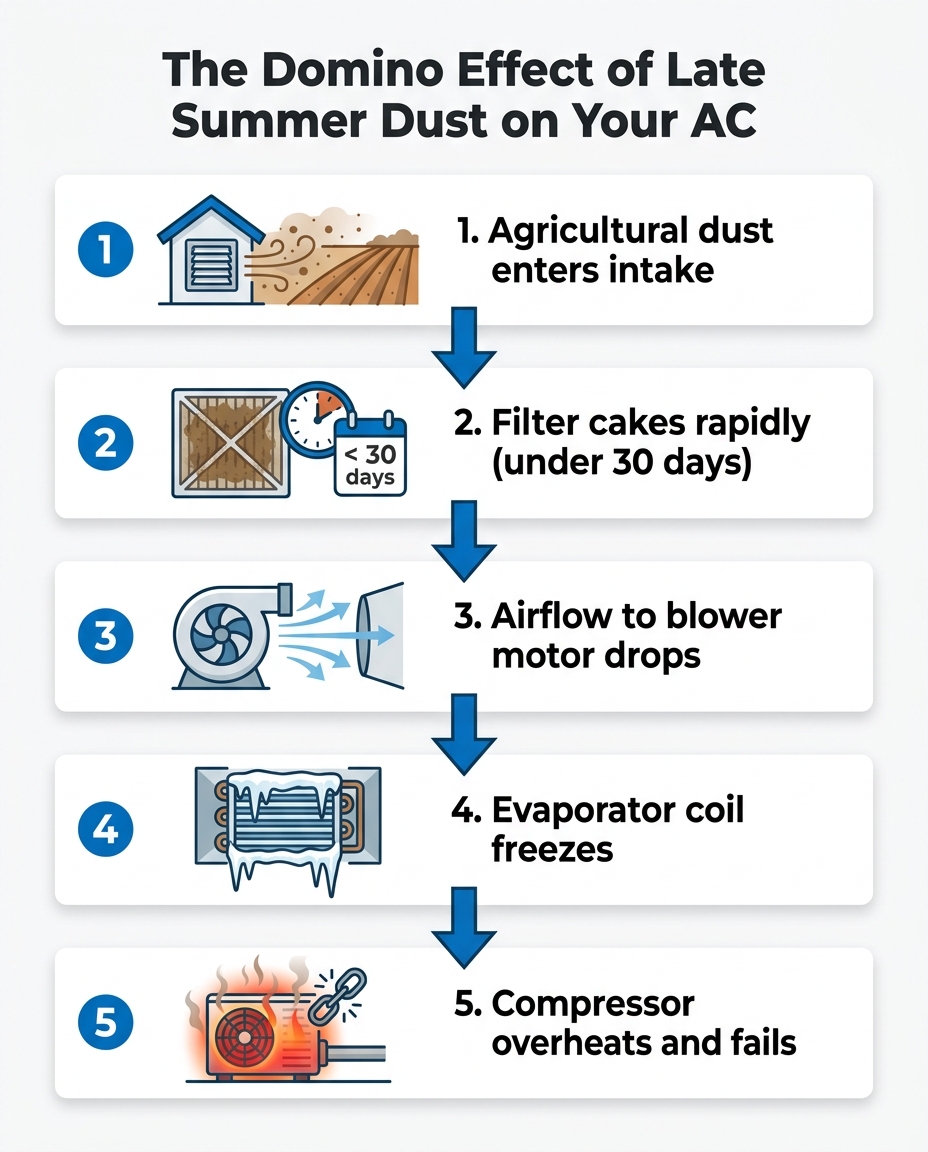
When heavy agricultural particles cake onto your filter media, they do not just dirty the filter—they create a physical wall. This wall stops air from flowing through the system, which triggers a dangerous chain reaction inside your air conditioner.
How Restricted Airflow Mechanically Strains Your Cooling System
Your air conditioner requires a precise, constant volume of air moving over its internal components to function correctly. When a filter becomes caked with central Iowa field dust, it chokes the return air, starving the blower motor of the volume it needs. This is where a simple, inexpensive maintenance task turns into a major mechanical crisis.
The Problem: Starved Airflow
As the filter clogs, the blower motor has to work twice as hard to pull the same amount of air into the system. This immediately increases wear and tear on the motor itself, risking an electrical short or a burned-out motor bearing.
The Cause: Freezing Evaporator Coils
Inside your indoor unit sits the evaporator coil, which is filled with extremely cold refrigerant. Under normal conditions, warm air from your house blows over this coil, transferring heat into the refrigerant. When a clogged filter restricts that warm airflow, the coil's temperature drops rapidly below freezing. The natural condensation on the coil turns to solid ice, completely encasing the unit.
The Solution: Immediate Professional Intervention
Once the indoor coil freezes, the outdoor compressor continues to pump refrigerant, but the heat transfer process has stopped. Liquid refrigerant can flow backward into the outdoor compressor, causing it to overheat and fail catastrophically. One Des Moines homeowner found this out the hard way last summer when their air conditioner suddenly stopped working entirely on a sweltering afternoon. They called our team for help, and a Midwest Comfort technician arrived in under two hours, quickly diagnosing that restricted airflow had caused the system to shut down. The air conditioning services were completed and cooling was restored in less than an hour, but the experience highlighted how fast a system can fail when it cannot breathe.

The Hidden Energy Costs of a Clogged Filter
Beyond the immediate risk of a mechanical breakdown, neglecting your filter during the August and late summer agricultural transition forces you to pay significantly more to cool your home. The EPA and DOE consistently warn that restricted airflow is the leading cause of poor energy efficiency in residential HVAC systems.
When your air conditioner is struggling to pull air through a wall of dust, it has to run much longer cycles to reach the temperature set on your thermostat. Instead of running for a standard fifteen-minute cycle, the system might run for forty-five minutes or even continuously. Every extra minute the compressor runs is electricity you are paying for, causing utility bills to spike sharply during the hottest weeks of the year.
Furthermore, a severely clogged filter can induce short-cycling. This happens when the system overheats, shuts down prematurely as a safety precaution, and then turns back on a few minutes later. Short-cycling draws massive surges of electricity every time the system starts up, completely destroying your home's energy efficiency. It also prevents the system from running long enough to dehumidify the air, leaving your home feeling sticky and uncomfortable.
Maintaining routine filter diligence is the easiest way to keep your monthly operational costs low. As our technicians at Midwest Comfort Heating & Cooling often note, ensuring your system can breathe freely is exactly how routine AC maintenance boosts performance. A clean filter allows the system to cool the home quickly, shut off normally, and consume exactly the amount of power it was designed to use.
Adjusting Your Filter Replacement Schedule for Harvest Season
To protect your home during the August and late summer agricultural transition, you need to throw out the standard 90-day rulebook. Here is exactly how to adjust your filter replacement schedule to combat central Iowa's harvest season dust.
1. Switch to a bi-weekly visual inspection: Do not wait for the first of the month. During peak harvest season, pull your filter out every two weeks. A visual inspection takes less than a minute but provides immediate insight into how heavily the local air is impacting your system.
2. Perform the light test: You cannot always judge a filter just by looking at the surface. Hold the filter up to a bright overhead light or a window. If you cannot see light shining through the media, the filter is completely caked with particulate matter and is restricting airflow. It must be replaced immediately, regardless of how long it has been installed.
3. Balance your MERV ratings: High MERV (Minimum Efficiency Reporting Value) ratings trap smaller particles, but they also restrict airflow by design. If you use a MERV 11 or MERV 13 filter to combat agricultural dust, it will clog much faster than a standard MERV 8. If you choose high-filtration models, you must be prepared to replace them incredibly frequently during late summer.
4. Stockpile correct-size filters in advance: The worst time to realize you need a new filter is on a Sunday evening when the hardware store is closed. Buy a multi-pack of the correct size filters before the harvest dust peaks, so you can swap out a dirty filter the moment you spot an issue.
By taking a proactive, hyper-local approach to your filter schedule, you eliminate the number one cause of end-of-season cooling failures.
Why Expert HVAC Maintenance Matters Most in Late Summer
While checking and changing your air filter is a critical homeowner task, it is only the first line of defense. Once heavy agricultural dust bypasses a clogged or poorly fitted filter, it begins to coat the internal components of your HVAC system. Cleaning caked-on dust out of blower wheels, electrical contactors, and delicate evaporator coils requires professional tools and expertise.
This is where an end-of-season tune-up becomes invaluable. A professional inspection catches the hidden wear-and-tear caused by weeks of heavy dust exposure. When technicians open the cabinet, they can measure the exact electrical draw of the blower motor to ensure it hasn't been permanently damaged by restricted airflow. They can also implement a comprehensive approach to indoor air quality that goes far beyond just the standard 1-inch disposable filter, utilizing advanced media cabinets or whole-home purifiers tailored to the region.
Our deep understanding of central Iowa's unique environmental and agricultural challenges allows us to provide targeted, highly effective system protection. A pattern we see often is that homeowners who rely on our regular, twice-yearly service ensure their AC and furnace are running in top shape despite the harvest dust. By having our technicians provide thorough service, call ahead, and answer questions about local air quality, they feel completely confident in their system's performance no matter how dusty it gets outside. Scheduled check-ups are the ultimate defense against regional environmental strain.
Common Questions About Des Moines Air Quality and HVAC Filters
Why is my AC filter getting dirty so fast in summer?
The short answer is that dry soil and agricultural activity drastically increase the amount of airborne dust in the late summer. When your AC runs frequently to combat the heat, it pulls a massive volume of this dust-heavy air through the return vents. This heavy particulate load causes filters to clog in a fraction of the time they would during a mild spring season.
How often should I change my HVAC filter in Iowa?
Most homeowners don't realize that standard 90-day guidelines do not apply during harvest season. In central Iowa, you should visually inspect your filter every two weeks during late summer and fall. If the filter fails the light test, you may need to replace it every 30 days to protect your system's airflow.
Does a dirty filter affect AC cooling?
Yes, a dirty filter severely impacts your air conditioner's ability to cool your home. By choking off the warm return air, the system cannot absorb heat effectively, leading to weak airflow at the vents and longer cooling cycles. Your home will feel warmer and more humid, even though the unit is running constantly.
Can a dirty filter break my AC?
If you notice a sudden lack of cold air, a dirty filter is often the culprit, and ignoring it can absolutely cause a breakdown. Restricted airflow causes the indoor evaporator coil to freeze solid, which can force liquid refrigerant back into the outdoor compressor. This mechanical strain frequently leads to total compressor failure, which is a major repair.
What happens if you don't change your AC filter?
Failing to change your filter forces the blower motor to work harder, driving up your monthly utility bills. Eventually, the dust will bypass the filter entirely, coating the internal components and causing the system to overheat or freeze. Over time, this neglect strips years off the lifespan of your entire HVAC system.
How does harvest dust impact Des Moines indoor air quality?
Harvest dust introduces high levels of PM10 and PM2.5 particulate matter into the air, which easily infiltrates homes through open doors, drafts, and HVAC intakes. Once inside, these dense agricultural particles can aggravate allergies and respiratory issues. Maintaining clean, high-quality filters is essential for keeping this outdoor dust out of your living spaces.
Protect Your AC from Late Summer Dust Today
Central Iowa's seasonal transition brings unique challenges that standard maintenance manuals simply do not cover. Proactive filter management is your best defense against the heavy agricultural dust that threatens to suffocate your cooling system. By checking your filters frequently and replacing them the moment they become caked, you can ensure your home stays comfortable without overworking your equipment.
Don't wait for your system to freeze over during the lingering August heat. Take a moment to check your air filter today. If your system is already showing signs of strain, or if you want to explore advanced filtration options to combat local dust, reach out for a professional inspection. Protect your comfort and your equipment by scheduling a comprehensive check-up today.
Customer Testimonials
Service Areas
