



The Hidden Link Between High Indoor Humidity and Oversized AC Units in Polk County
The Frustration of a Cold, Sticky House
Your air conditioner is blasting cold air, but your living room still feels like a damp cave, which often points directly to the hidden link between high indoor humidity and oversized AC units in Polk County. You walk inside after a long day in the summer sun, expecting a refreshing chill. Instead, the air feels heavy. Your skin feels clammy, the floors might even feel slightly slick, and you find yourself constantly adjusting the thermostat trying to find a comfortable balance.
The most common reaction to this uncomfortable sensation is assuming the air conditioner is broken, failing, or simply not powerful enough to handle the square footage of your home. If the house feels gross and sticky, the logical conclusion is that you need a bigger, stronger unit to push more cold air into the rooms. However, the reality of heating and cooling physics tells a completely different story. The system might actually be too powerful for the space it is trying to cool.
Air conditioning was not invented just to lower the temperature; it was originally designed to pull moisture out of the air. To achieve true comfort, a system must manage both the thermal temperature and the moisture levels simultaneously. When you experience high indoor relative humidity despite a low thermostat setting, your equipment is failing at its secondary—but equally important—job of wringing out the air. Understanding how these systems integrate with residential HVAC systems as a whole is the first step to solving that cold, sticky feeling once and for all.
Understanding Sensible vs. Latent Heat in Your Home
To understand why a powerful air conditioner can leave your house feeling like a swamp, you have to understand the two different types of heat your system is fighting. July peak summer heat and humidity in the midwest brings a heavy burden to your home, making moisture removal just as critical as temperature reduction. Heating and cooling professionals categorize this burden into sensible heat and latent heat.
Sensible heat is exactly what it sounds like: the heat you can sense and measure with a standard thermometer. When the weather report says it is 95 degrees outside, that is sensible heat. Latent heat, on the other hand, is the thermal energy trapped within the moisture suspended in your indoor air. You cannot read latent heat on a basic thermostat, but your body definitely feels it. It is the reason an 80-degree day in the dry desert feels comfortable, while an 80-degree day in the midwest feels miserable.
• Sensible Heat — What It Is: The actual temperature of the air — How It Is Measured: Standard thermometer — How the AC Handles It: Cools the air quickly by blowing it over cold coils
• Latent Heat — What It Is: The moisture/humidity trapped in the air — How It Is Measured: Hygrometer (relative humidity %) — How the AC Handles It: Requires long run times to slowly extract water vapor
A properly functioning air conditioner must run long enough to pull warm, moist air across its freezing-cold evaporator coil to extract this latent moisture. Dehumidification takes significantly more time than simply dropping the sensible air temperature. If you are looking into air conditioning installation and sizing, knowing how these two forces interact is essential to getting the right equipment for your specific needs.
How Your Air Conditioner Wrings Out Moisture
Think of your evaporator coil like a glass of ice water sitting on your patio on a hot summer afternoon. Almost immediately, water droplets form on the outside of the glass. The cold surface is pulling moisture out of the warm air. Your air conditioner does the exact same thing on a massive scale.
• The condensation phase: Warm indoor air is blown across the chilled evaporator coils, causing the suspended moisture to condense into liquid water.
• The drainage phase: That liquid water drips down into a drain pan and is safely channeled outside of your home.
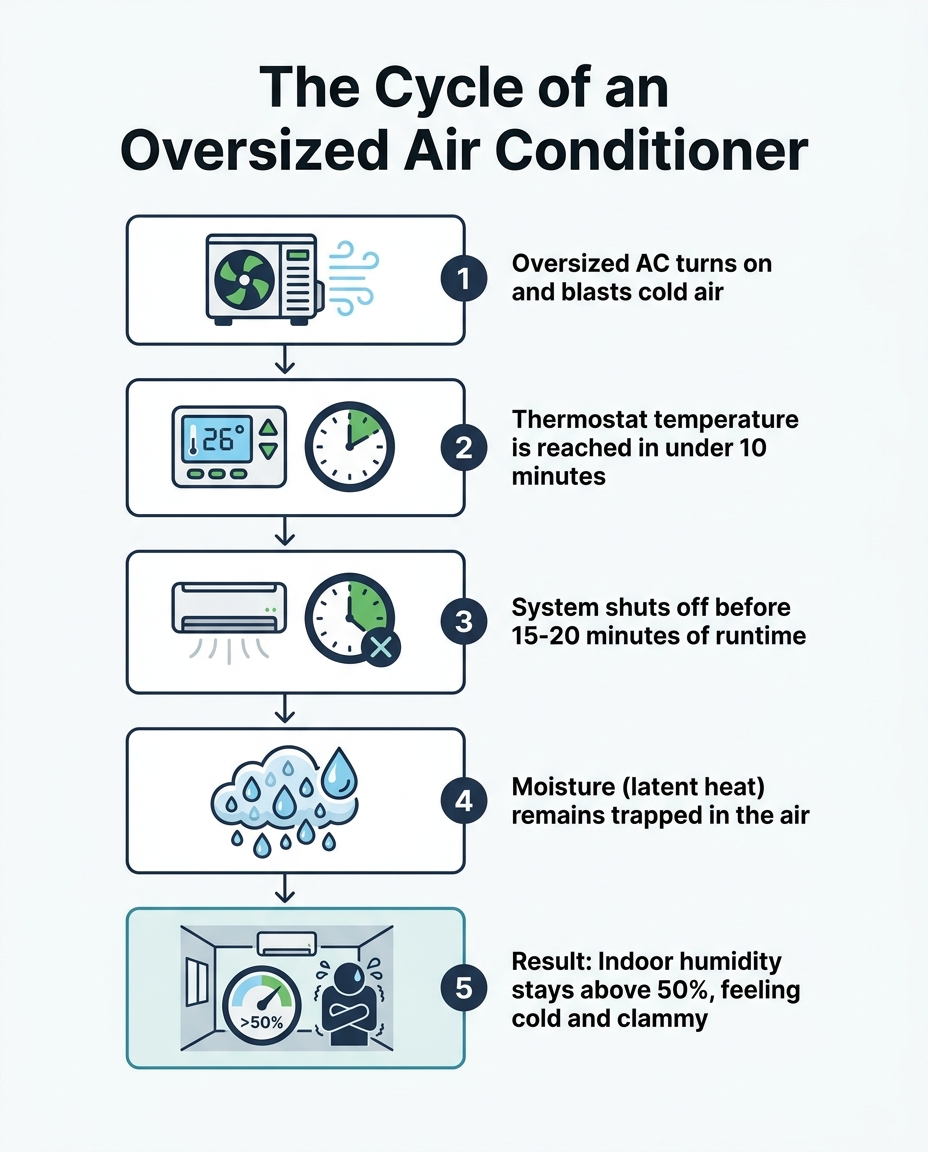
• The time requirement: Air must circulate over this coil continuously for 15 to 20 minutes to effectively dehumidify the entire volume of air in your house.
If the cooling cycle is too short, the sensible temperature drops, but the latent moisture stays suspended in the air, leaving you shivering but sweating.
What is AC Short-Cycling and Why Does It Happen?
When an air conditioner turns on, runs for a brief burst of five to ten minutes, and then shuts right back off, it is experiencing a mechanical fault known as "short-cycling." This rapid on-and-off behavior is a massive red flag for Polk County / Des Moines area homes. While there are a few different triggers for this issue, an oversized air conditioning unit is one of the most common and difficult to correct.
An oversized unit is simply too large for the square footage and thermal envelope of the house. When it kicks on, it blasts the rooms with a massive volume of freezing air. The thermostat, which only measures sensible heat, registers that the target temperature has been reached in just a few minutes. Satisfied, the thermostat tells the system to shut down.
Because the rapid cooling shuts the system down before it has time to extract the latent heat, the humidity remains trapped indoors. The air is cold, but the moisture is still there. Beyond the terrible comfort levels, short-cycling puts immense stress on your equipment. The compressor and blower motor consume the most electricity and endure the most physical wear during the startup phase. Turning on and off rapidly drastically shortens the lifespan of these expensive components. If you are currently troubleshooting AC issues, timing your system's run cycles is a great place to start.

The Thermostat Trap: Why Lowering the Temperature Fails
When your living room feels warm and sticky, the most natural instinct in the world is to walk over to the wall and bump the thermostat down two or three degrees. It makes logical sense: if you feel hot, you ask the machine for more cold. But when you are dealing with high indoor relative humidity despite a low thermostat setting, this instinct backfires completely.
Cold air holds less moisture than warm air. When you lower the temperature without removing the water vapor, the relative humidity actually increases. The house becomes freezing cold, but the unit still shuts off too quickly to wring out the water. You end up creating a "cave-like" atmosphere—cold, dark, and distinctly damp. You grab a blanket because you are shivering, but your skin still feels sticky.
Ideal indoor humidity should hover between 30% and 50% during the summer months. When an oversized unit short-cycles, it often leaves the indoor relative humidity well above 60%. At those levels, your sweat cannot evaporate, making the air feel much hotter than the thermometer claims. Furthermore, sustained high humidity creates an ideal breeding ground for biological growth in your ductwork and dark corners. Correcting the moisture balance is a critical part of comprehensive indoor air quality solutions.
Debunking the 'Bigger is Better' Air Conditioning Myth
There is a persistent myth among homeowners—and even some inexperienced contractors—that a larger tonnage unit is always an upgrade. If a 2.5-ton unit cools the house, a 3.5-ton unit must cool it better and faster, right? This logic treats HVAC systems like car engines, assuming excess horsepower is a luxury. In reality, excess capacity in an air conditioner is entirely detrimental to your comfort and efficiency.
A typical pattern we see in Polk County / Des Moines area homes involves homeowners replacing older units and requesting a larger size "just to be safe." One homeowner needed to replace a 30-year-old AC and furnace unit. Instead of just throwing a massive, oversized condenser on the pad, the installers worked carefully with the customer to ensure the new system was perfectly sized for the home's actual load. The team even coordinated with neighbors to complete the job right on time despite a major driveway replacement happening next door. Because the new unit was correctly sized rather than upsized, it provided vastly superior comfort and dehumidification compared to the old equipment.
The negative impacts of an oversized system include:
• Higher utility bills: The massive power draw of constant starting and stopping consumes far more electricity than a smaller unit running steadily.
• Uneven cooling: The rooms closest to the blower freeze instantly, while the thermostat shuts the system down before distant bedrooms receive any conditioned air.
• Severe humidity issues: As discussed, the lack of continuous airflow over the evaporator coil leaves the home feeling like a swamp.
Right-sizing a unit means matching its capacity perfectly to the specific square footage, layout, and thermal envelope of the house. Bigger is never better; exactly right is better.
Is Your System Oversized, or Just Underperforming?
Before you panic and assume your entire system needs to be replaced due to sizing issues, it is important to rule out maintenance deficits. A system that is struggling to breathe will exhibit many of the exact same symptoms as an oversized unit, especially during July peak summer heat and humidity. If the airflow is restricted, the evaporator coil cannot extract moisture efficiently.
A system might fail to remove humidity for several correctable reasons. Dirty evaporator coils act as an insulator, preventing the warm air from touching the cold refrigerant lines. Clogged condensate drains can cause water to back up and re-evaporate into the ductwork. Leaky return ducts might be pulling humid, unconditioned air directly from your attic or crawlspace and blowing it into your living room.
Routine maintenance can often resolve these airflow issues that mimic sizing problems. For example, during a scheduled service visit, a local homeowner asked for maintenance and advice on their heating and cooling units because the house felt constantly damp. The technician provided professional work and excellent advice for energy efficiency, discovering that a severely clogged filter and a dirty blower wheel were severely restricting the system. Once the furnace and air conditioner were serviced efficiently with energy-saving tips applied, the system could finally run long enough to dehumidify the space. Keeping up with routine AC maintenance ensures that if your system is short-cycling, you know it is a sizing issue, not just a dirty filter.
The True Fix: Precision Load Calculations for Lasting Comfort
If your system is clean, well-maintained, and still short-cycling while leaving your home feeling clammy, sizing is the likely culprit. The only authoritative solution to this problem is a professional Manual J load calculation. This is the gold standard for determining exactly how much cooling capacity a specific house requires.
A Manual J load calculation goes far beyond simply measuring the square footage of the floor. A professional technician will measure the size and quality of your windows, check the depth of your attic insulation, map the sun exposure on different sides of the house, and calculate the heat generated by your appliances. They contrast this highly detailed mathematical model against the outdated "rule-of-thumb" guessing that lazy contractors use when they simply divide square footage by 500 to pick a tonnage.
Polk County summer climate data indicates frequent high dew points, making precision load calculations absolutely non-negotiable for managing heavy moisture loads. Midwest Comfort Heating & Cooling relies strictly on professional load calculations rather than rule-of-thumb guessing to ensure perfect dehumidification for Polk County / Des Moines area homes. A properly sized unit runs longer, slower cycles, effectively wringing out humidity while maintaining a steady, comfortable temperature. It improves your daily comfort, protects your indoor air quality, and operates far more efficiently over its lifespan.
Frequently Asked Questions About AC Sizing and Humidity
Why does my house feel damp when the AC is running?
Your house feels damp because the air conditioner is cooling the air temperature without running long enough to extract the moisture. This often happens when you have high indoor relative humidity despite a low thermostat setting. The system blasts cold air, satisfies the thermostat quickly, and shuts off before the condensation process can pull the water vapor out of your living space. The result is a cold, clammy environment.
What is AC short-cycling?
Short-cycling is a mechanical issue where the air conditioner turns on, runs for a very brief period (usually under ten minutes), and then shuts off abruptly. This rapid on-and-off pattern prevents the system from completing a full cooling and dehumidification cycle. It is frequently caused by an oversized unit, restricted airflow, or a malfunctioning thermostat, and it puts severe wear and tear on the compressor.
Can an oversized AC cause mold?
Yes, an oversized AC can indirectly contribute to mold growth by failing to control indoor moisture levels. Because the unit short-cycles and leaves the relative humidity consistently above 50% or 60%, the damp environment becomes highly hospitable to biological growth. Mold thrives in dark, humid spaces, and an oversized unit practically guarantees that moisture remains trapped inside your walls and ductwork.
How long should an AC run to dehumidify?
A properly sized air conditioner needs to run continuously for at least 15 to 20 minutes during a standard cooling cycle to effectively dehumidify a home. It takes time for the indoor air to circulate over the cold evaporator coils and for the moisture to condense and drain away. Cycles shorter than 15 minutes generally leave excess latent heat (humidity) suspended in the air.
What happens if my AC is too big for my house?
If your AC is too big, it will cool the house too rapidly and shut down before removing the humidity, leaving you cold but sticky. Additionally, the constant starting and stopping will cause your utility bills to spike, as the system draws the most power upon startup. The excessive cycling also wears out critical components like the compressor and contactor much faster than normal.
How do professionals determine the correct AC size?
Professionals determine the correct size by performing a strict Manual J load calculation. This process involves measuring the home's square footage, window efficiency, insulation levels, ceiling height, and directional sun exposure. They do not rely on simple square-footage rules of thumb, ensuring the chosen unit matches the exact thermal and latent heat load of the specific house.
Reclaim Your Summer Comfort
Living in a home that feels cold but clammy is a clear sign of poor dehumidification, often caused by an oversized unit short-cycling through its run times. Remember that simply lowering the thermostat will not solve the humidity problem; it will only make your damp house feel like a refrigerator. If you are tired of battling sticky air in your Polk County / Des Moines area home, it is time to stop guessing. Reach out for a professional evaluation of your system's sizing, airflow, and run-time cycles so you can restore true, lasting comfort to your living space.
Customer Testimonials
Service Areas
