



Upgrading Your Commercial HVAC Controls Before the Heating Season Begins
The Urgent Window for Evaluating Facility Climate Systems
As August arrives, the back-to-school transition begins, and the intense summer heat starts to break, upgrading your commercial HVAC controls before the heating season begins should be at the top of every facility manager's priority list. At Midwest Comfort Heating & Cooling, our team typically sees that the late-summer cooling wind-down represents a brief, critical pivot point in building operations. Right now, your cooling loads are steadily decreasing, but the heavy demands of winter heating have not yet arrived. This transitional period is the safest time of year to evaluate the systems that regulate your building's climate.
In our experience, relying on aging, legacy controls poses a massive liability as temperatures prepare to drop. Outdated thermostats and pneumatic systems that struggled through the summer will face an even harsher test when the Midwest winter sets in. Facility managers face a distinct decision point right now: initiate a transition to a modern, automated system during this quiet operational window, or risk catastrophic mid-winter downtime when your heating equipment is pushed to its absolute limit.
To ensure your building transitions smoothly into the colder months, evaluating your commercial HVAC systems is an essential first step. This guide bypasses basic definitions to focus on the strategic timing of control upgrades, the hidden risks of legacy equipment, and how a proactive approach in the August late-summer shoulder season protects your facility, your tenants, and your bottom line.
The Hidden Operational Risks of Legacy Pneumatic Controls
Many older Des Moines commercial facilities still rely on legacy pneumatic controls—systems that use compressed air, rather than digital signals, to open valves and adjust dampers. While these systems were once the industry standard, they carry significant, hidden vulnerabilities that compound over time. In our years servicing Des Moines commercial properties, a pattern we see often is the rapid physical degradation of these components. Air compressors wear out, plastic and copper airlines develop microscopic leaks, and the rubber diaphragms inside actuators become brittle and crack.
The cause of the inefficiency: When a pneumatic system loses air pressure or suffers from calibration drift, the controls can no longer accurately gauge or adjust the temperature. This leads to simultaneous heating and cooling, where the system fights itself to maintain a setpoint. Because commercial buildings consume approximately 30% of their total energy on HVAC operations, the financial impact of this energy waste is staggering. Poor zone control means you are paying to heat empty spaces, or over-heating occupied spaces simply because the legacy thermostat cannot read the room accurately.
The operational nightmare: Beyond energy waste, the real danger is sudden, unexpected failure. When mechanical controls fail, they often do so without warning, requiring emergency after-hours interventions to restore tenant comfort. Our technicians see this operational nightmare far too often. One of our local commercial clients experienced this firsthand when a legacy control component failed late in the evening. The facility manager called us for emergency service at 10 PM, knowing the building's temperature was rapidly dropping. Fortunately, our technician arrived the next morning and had the specific issue resolved within 30 minutes, restoring the system before business hours. However, a failure like that during a deep winter freeze could have resulted in a disastrous overnight temperature drop.
Waiting for aging systems to fail during peak heating loads is a dangerous gamble. Understanding the cost of delaying commercial HVAC repairs helps clarify why upgrading these controls is not just an efficiency measure, but a critical risk management strategy.
Why the Late Summer Shoulder Season is the Optimal Transition Window
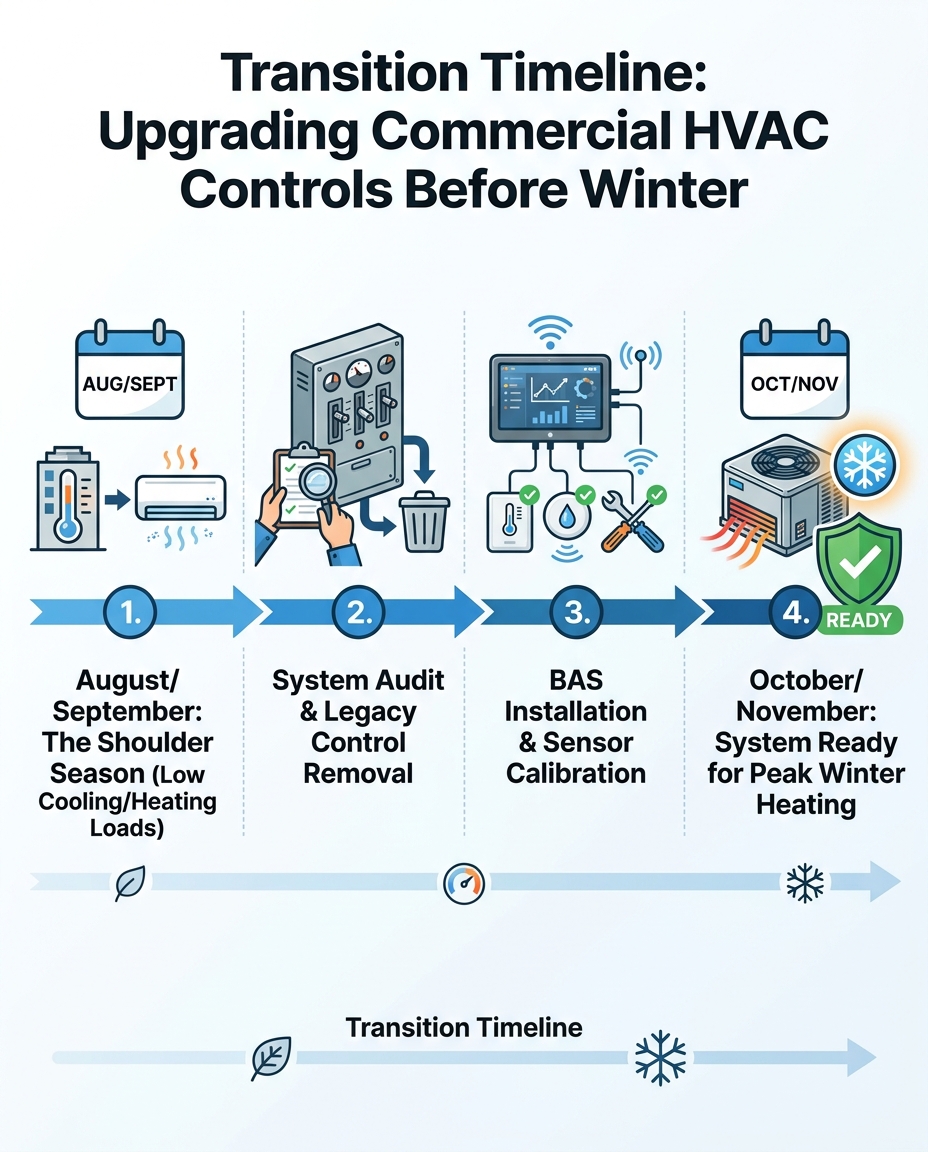
In facility management, timing is everything. We always advise our commercial clients that the "shoulder season"—the period in late August and September when cooling loads wind down and heating loads have not yet peaked—is the optimal window for major operational changes. During this time, the ambient outdoor temperature is mild enough that your building's internal climate remains relatively stable, even if portions of the HVAC system are temporarily taken offline for upgrades.
This window allows for systematic equipment changeovers without disrupting tenant comfort or compromising indoor air quality. Upgrading controls requires technicians to access terminal units, replace thermostats, run new communication wiring, and calibrate sensors. Attempting this during the peak of summer or the dead of winter means fighting against extreme outdoor temperatures, forcing technicians to rush, and leaving occupants uncomfortable.
Consider the stark difference between a planned late-summer transition and a reactive, mid-winter emergency replacement. A planned upgrade allows you to order parts without expedited shipping fees, schedule labor during normal business hours, and thoroughly test the system before it is needed. A reactive emergency replacement means paying premium overtime rates, waiting on backordered components while the building freezes, and scrambling to deploy temporary space heaters to keep tenants happy.
Furthermore, scheduling contractor availability is significantly easier before the winter rush begins. By late October, HVAC technicians are inundated with emergency "no-heat" calls across the region. Securing your spot on the schedule during the August late-summer shoulder season ensures you have dedicated experts focused entirely on your building's heating system upgrades, rather than fitting you in between emergency dispatch calls.

Preventing Catastrophic Winter Freeze-Ups and Structural Damage
The harsh, freezing realities of Des Moines winters present a unique threat to commercial buildings. When temperatures plummet well below freezing, a facility can suffer catastrophic pipe bursts if heating fails overnight. In a large commercial space, the perimeter zones—areas closest to exterior walls and windows—lose heat incredibly fast. If the HVAC controls fail to recognize this temperature drop and fail to signal the heating equipment to engage, the water lines running through those exterior walls can freeze, expand, and rupture in a matter of hours.
When our team designs control strategies for local businesses, automated controls are your first line of defense against structural damage. Modern control systems continuously monitor ambient temperatures across dozens or hundreds of specific zones. If a zone approaches a critical low-temperature threshold, the system automatically overrides standard occupancy schedules to initiate heating, preventing a freeze-up before it starts.
The power of remote alerts: Modern building automation systems (BAS) provide remote monitoring capabilities that legacy systems simply cannot match. If a boiler fails to ignite or a pump stops circulating hot water, the BAS immediately sends a push notification or email to the facility manager's phone. This real-time alert allows you to dispatch a technician immediately, turning a potential disaster into a routine maintenance call.
To achieve comprehensive protection, these advanced controls must be seamlessly integrated with heavy-duty heating equipment. Whether your facility relies on rooftop units, variable air volume (VAV) boxes, or commercial boiler systems, the controls act as the brain of the operation, ensuring that the mechanical brawn of your heating equipment deploys exactly when and where it is needed to protect your investment.
Core Advantages of Transitioning to Modern Building Automation Systems
Transitioning from outdated pneumatic or standalone digital thermostats to a comprehensive Building Automation System (BAS) transforms how a facility operates. A modern BAS networks all your HVAC equipment together, allowing components to communicate and share data in real time. For Des Moines commercial facilities, this upgrade provides tangible, long-term benefits that extend far beyond simply keeping the building warm.
Energy Efficiency and Cost Control
The most immediate advantage of a BAS is a drastic reduction in energy consumption. Modern controls allow for incredibly precise zone management and optimized scheduling. Upgrading to these modern systems may also qualify your facility for generally applicable energy rebates or utility incentive programs—we always advise our clients to verify current programs with their local utility provider or a tax professional.
• Optimizing start/stop times: Instead of manually guessing when to turn the heat on before employees arrive, a BAS uses algorithms to calculate the exact time the system needs to start based on the current outdoor temperature. This ensures the building is comfortable exactly at 8:00 AM, without wasting energy running the heat since 4:00 AM.
• Reducing unnecessary heating: Advanced controls integrate with occupancy sensors and access control systems to lower the temperature setpoint in vacant conference rooms, empty floors, or unused warehouse sectors, slashing energy waste during unoccupied hours.
Predictive Maintenance and Reliability
Legacy systems operate on a run-to-failure model; you only know a part is broken when the room gets cold. A modern BAS shifts your facility to a predictive maintenance model.
• Data-driven insights: The system monitors the runtime, electrical draw, and performance of every motor, fan, and compressor. If a blower motor starts drawing more amperage than usual, the BAS flags it as a potential upcoming failure, allowing you to replace the part before it causes a system-wide shutdown.
• Extending equipment lifespan: By preventing short-cycling (where equipment turns on and off rapidly) and ensuring components only run when necessary, automated controls significantly reduce the mechanical wear and tear on your core HVAC equipment.
To highlight the stark differences, consider how legacy and modern systems handle daily operations:
• Communication — Legacy Pneumatic Controls: Compressed air lines (prone to leaks) — Modern Building Automation (BAS): Digital BACnet protocols (instant data)
• Monitoring — Legacy Pneumatic Controls: On-site physical inspection only — Modern Building Automation (BAS): Remote access via smartphone or web
• Alerts — Legacy Pneumatic Controls: None (tenant complaints act as alerts) — Modern Building Automation (BAS): Automated push notifications for faults
• Zone Control — Legacy Pneumatic Controls: Inaccurate, subject to calibration drift — Modern Building Automation (BAS): Precise, micro-adjustments based on occupancy
Finally, modern controls offer seamless integration with other essential building management systems, such as lighting, fire alarms, and security, creating a truly smart building ecosystem.
Structuring a Zero-Downtime Upgrade Plan
The prospect of replacing a building's entire control system can seem daunting, but a structured, phased approach ensures the transition is manageable and minimally disruptive. The goal is to execute the upgrade during the August late-summer shoulder season with zero unplanned downtime.
Phase 1: Comprehensive Auditing. The process begins with a deep-dive audit of your existing pneumatic or legacy digital controls. Technicians map out the current infrastructure, identifying which airlines can be abandoned, which actuators need replacement, and where new digital communication wire must be pulled. This audit establishes the baseline for the new system's programming.
Phase 2: Phased Implementation. A zero-downtime transition relies on phasing. Rather than taking the entire building offline, the installation team upgrades one floor, one wing, or one specific air handler at a time. This ensures that the majority of the facility remains climate-controlled while the swap occurs. Old pneumatic thermostats are removed, new digital sensors are mounted, and the terminal units are connected to the new BAS network.
Success in this phase requires partnering with local experts who understand regional building codes and the specific climate demands of the Midwest. When we execute these upgrades at Midwest Comfort Heating & Cooling, you benefit from our localized commercial expertise; our teams know exactly how to engineer control sequences that protect against deep freezes while ensuring businesses experience a seamless transition with zero winter downtime.
Phase 3: Ongoing Calibration and Upkeep. An upgraded control system is highly intelligent, but it still requires professional oversight to perform at its peak. Post-installation, technicians fine-tune the PID (Proportional-Integral-Derivative) loops to ensure valves open and close smoothly without hunting or overshooting the setpoint. Integrating the new controls into a routine HVAC maintenance plan guarantees that sensors remain clean, software stays updated, and the system continues to deliver maximum energy savings year after year.
Frequently Asked Questions
When is the best time to upgrade commercial HVAC controls?
The optimal time for an upgrade is during the late summer or early fall "shoulder season." During this period, cooling demands are decreasing, and heavy winter heating loads have not yet begun, allowing technicians to perform systematic changeovers without causing extreme temperature fluctuations inside the building.
What are the risks of outdated commercial HVAC controls?
Legacy controls are highly susceptible to calibration drift, air leaks, and sudden mechanical failure. These issues lead to massive energy waste due to simultaneous heating and cooling, and they pose a severe risk of sudden system shutdowns that can leave a facility vulnerable to freezing temperatures.
How long do commercial HVAC controls last?
Most commercial HVAC control systems have a reliable lifespan of 15 to 20 years. Beyond this point, pneumatic systems suffer from degraded airlines and actuators, while older digital systems become obsolete, making replacement parts difficult to find and software impossible to update securely.
What is a building automation system (BAS)?
A BAS is a centralized, networked system that controls a facility's heating, ventilation, and air conditioning, often integrating with lighting and security. It uses digital sensors and software algorithms to optimize equipment operation, reduce energy consumption, and provide remote monitoring capabilities to facility managers.
How do modern HVAC controls prevent winter pipe bursts in commercial buildings?
Modern controls continuously monitor the ambient temperature in highly vulnerable perimeter zones. If the temperature approaches freezing, the system automatically overrides standard unoccupied schedules and engages the heating equipment, sending instant alerts to management before structural damage occurs.
Can building automation systems reduce commercial energy consumption?
Yes, a modern BAS significantly reduces energy use by implementing precise start/stop scheduling, lowering setpoints in unoccupied zones, and preventing the HVAC system from running simultaneous heating and cooling cycles. These efficiencies often result in substantial utility savings that help offset the cost of the upgrade.
Take Control Before the Cold Arrives
Waiting until the first freeze to realize your legacy controls are failing is a risk no facility manager should take. By acting during the late summer shoulder season, you secure a reliable, energy-efficient system well before the winter rush. For a clear, professionally grounded evaluation of your building's transition to modern automation, reach out to schedule your commercial control audit today.
Customer Testimonials
Service Areas
