



Why Your Basement Dehumidifier is Working Overtime in Late August
Is Your Basement Dehumidifier Running Non-Stop This August?
If you are wondering why your basement dehumidifier is working overtime in late August, you are certainly not alone. As families gear up for the back-to-school transition and we push through the end-of-season cooling demands, our team at Midwest Comfort Heating & Cooling fields countless calls about that constant, unrelenting hum coming from downstairs. You walk into the basement, hear the compressor grinding away, and yet the air still feels heavy, damp, and uncomfortable. It is incredibly frustrating to run an appliance continuously without feeling a noticeable difference in your home's comfort.
Homeowners often face a critical decision point at the end of the summer: determining if their unit is simply battling peak seasonal moisture loads or if it has suffered a mechanical failure. Late-summer weather brings unique environmental challenges that place immense stress on indoor air systems. Assessing your indoor air quality solutions is the first step toward regaining control over your home's moisture levels. Ultimately, investing in a routine maintenance plan can prevent these late-season surprises from escalating into full system breakdowns.
The Late-Summer Double Threat: Ground Saturation Meets Ambient Humidity
The underlying problem: By the time August rolls around, your home has endured months of weather fluctuations. In our years of servicing Des Moines homes, we frequently see a specific meteorological phenomenon at the end of the summer season that we call the "double threat" for basements. Late August weather in our area typically features high morning humidity exceeding 70%. When this heavy, moist outdoor air infiltrates the naturally cooler environment of your basement, the air's capacity to hold water drops, causing relative humidity levels to spike drastically.
The environmental cause: This ambient humidity is only half of the equation. The other half comes from the ground itself. Cumulative summer thunderstorms lead to peak ground saturation around your home's foundation. The soil absorbs massive amounts of rainfall over the preceding months, creating an intense envelope of moisture pressing against your basement walls. This combination creates a uniquely heavy moisture load that standard, standalone dehumidifiers are simply not sized to handle efficiently.
The structural solution: Addressing this double threat requires looking beyond a single appliance. While a dehumidifier treats the symptom, mitigating ground moisture through proper exterior drainage and supporting the basement with whole-home HVAC integration provides a much more robust defense against late-summer dampness.
Understanding Hydrostatic Pressure
To fully grasp why your basement feels so damp in August, it helps to understand hydrostatic pressure. In simple terms, hydrostatic pressure is the physical force exerted by resting water due to the pull of gravity. When the soil around your foundation becomes completely saturated from late-summer storms, that trapped water has nowhere to go. It pushes heavily against your porous concrete foundation walls.
Because concrete is naturally porous, this pressure forces water vapor directly through the foundation and into your basement air. The most deceptive part of hydrostatic pressure is that it happens invisibly. You do not need to see standing water, puddles, or active leaks for massive amounts of moisture to enter your home. Your dehumidifier is left working around the clock to extract water that the ground is actively pushing inside.
Overwhelmed vs. Broken: Diagnosing a Continuously Running Unit
A pattern we see often on late-summer service calls is homeowners assuming their unit is broken when it is actually functioning exactly as designed, but is simply overwhelmed by the late-summer moisture load. An overwhelmed unit will run non-stop but will still actively extract water, filling its bucket or draining steadily through its hose. A broken unit, on the other hand, will run its fan constantly without actually pulling any moisture from the air.
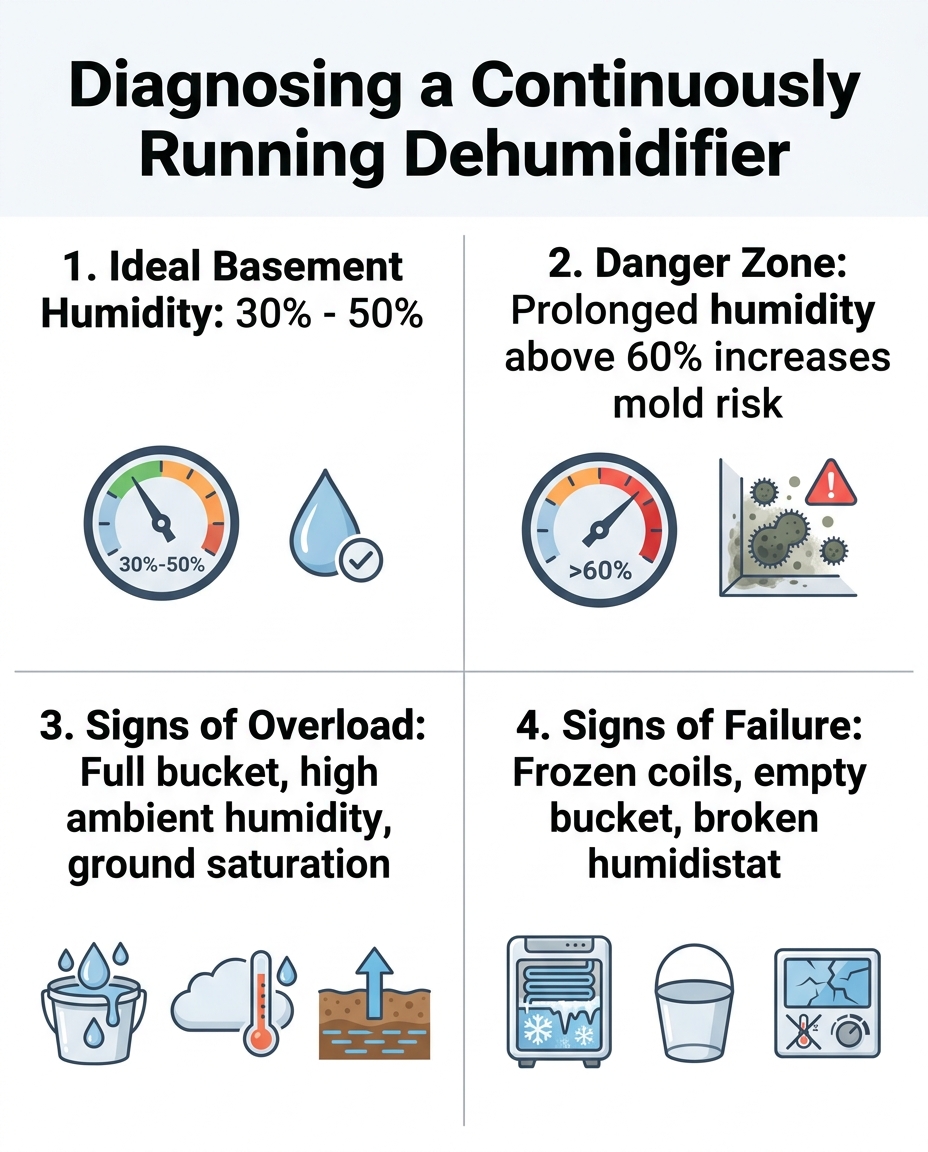
The most critical warning sign to watch for is the indoor humidity reading. If you monitor the space and find the relative humidity stuck above 55% despite continuous operation, there is a systemic issue at play. Ideal indoor relative humidity should always remain between 30% and 50% to prevent mold proliferation and protect your home's structural integrity. You can test your unit's effectiveness safely by emptying the bucket completely, setting the humidistat to a low setting, and checking back in a few hours to see if water has accumulated and if the compressor is cycling properly.
• Water Collection — Overwhelmed Unit: Bucket fills rapidly; constant draining. — Mechanically Broken Unit: Bucket remains dry or fills extremely slowly.
• Air Output — Overwhelmed Unit: Exhaust air feels slightly warm and dry. — Mechanically Broken Unit: Exhaust air feels room temperature and damp.
• Relative Humidity — Overwhelmed Unit: Hovering around 50-55% but struggling to drop lower. — Mechanically Broken Unit: Relative humidity stuck above 55% despite continuous operation.
• Compressor Noise — Overwhelmed Unit: Cycles on and hums steadily. — Mechanically Broken Unit: Fan runs, but compressor never kicks on (or clicks off immediately).

Signs of Mechanical Failure in Your Dehumidifier
If you have ruled out an environmental overload, your machine may be experiencing a mechanical failure. Dehumidifiers are essentially small refrigeration systems, and they suffer from similar breakdowns as your primary air conditioning unit. When these components fail, the machine often runs continuously to compensate for its inability to reach the target humidity setting.
1. Frozen evaporator coils: If you remove the filter and see a block of ice forming on the metal coils, the unit cannot extract moisture. This usually happens due to severely restricted airflow from a clogged filter or operating the unit in temperatures that are too low for the specific model. The machine will run its fan endlessly trying to thaw the ice.
2. Broken humidistats: The humidistat is the internal sensor that reads the room's moisture levels. If this sensor breaks or becomes coated in dust, it tricks the unit's control board into thinking the room is always too humid. The compressor will run 24/7 because it never receives the signal that the target humidity has been reached.
3. Low refrigerant levels: Dehumidifiers use a chemical refrigerant to cool the coils so that moisture condensates out of the air. If there is a micro-leak in the copper lines, the compressor will run continuously without actually cooling the coils enough to pull water from the air. You will hear the machine working, but the bucket will stay empty.
A crucial safety note: Internal electrical diagnostics and refrigerant repairs require specific certifications, specialized tools, and a licensed professional. Attempting to recharge a dehumidifier's refrigerant or rewire a control board as a DIY project is dangerous and will void your equipment's warranty.
Why Standalone Units Struggle Without Whole-Home Support
The limits of localized cooling: A standalone basement unit is ultimately just a localized fix for a whole-home pressure and moisture dynamic. Many homeowners expect a single, portable appliance to manage the humidity for an entire subterranean footprint. However, moisture naturally migrates from areas of high concentration to areas of low concentration. If the upper levels of your home are humid, that heavy air will eventually find its way down into the basement, forcing the standalone unit to work continuously.
The role of primary cooling: Your primary cooling equipment plays a massive, often overlooked role in removing ambient moisture from the upper levels, which directly impacts the basement's environment. Properly functioning air conditioning systems act as whole-home dehumidifiers during the summer months. As they pull warm air across their indoor evaporator coils, they strip gallons of water out of your home's air every single day.
Connecting AC to indoor air quality: The effectiveness of your central air conditioning is tightly connected to your overall indoor air quality and humidity control. If your central system is short-cycling, undersized, or oversized, it will fail to remove adequate moisture upstairs. If the entire house feels sticky and the basement unit cannot keep up, it is highly recommended to explore why your AC isn't dehumidifying your home properly rather than simply buying a larger basement unit.
The Value of Professional Diagnostics and Ongoing Care
Moving beyond basic troubleshooting: When you are dealing with persistent high humidity that stubbornly refuses to drop, the situation requires expert, technical diagnosis rather than basic DIY troubleshooting. Guesswork often leads to purchasing unnecessary equipment or ignoring a larger structural issue. Professional technicians have the tools to measure exact airflow, static pressure, and whole-home moisture loads accurately.
Comprehensive system assessment: Utilizing professional HVAC services allows you to assess the entire home's airflow, ductwork, and cooling performance. By optimizing the central system, you relieve a massive amount of the burden placed on localized basement units. At Midwest Comfort Heating & Cooling, we bring deep, localized expertise in diagnosing Iowa-specific indoor air quality issues, taking a comprehensive approach that considers how Des Moines weather patterns interact with your specific home architecture.
The preventative advantage: There is immense peace of mind that comes with regular system check-ups. Ensuring your equipment is in top shape before peak seasonal loads hit prevents catastrophic equipment failure when you need the systems most. Accurate diagnostics matter year-round. For example, during a recent end-of-season cooling failure, a homeowner's central AC stopped pushing cool air entirely. Instead of pushing for a full system replacement, our thorough diagnostic check revealed a faulty blower motor. By replacing just that specific component, the cooling and dehumidification were restored efficiently. Catching minor issues early—whether it is a struggling blower motor or a failing evaporator coil in late summer—keeps your home comfortable and your systems running smoothly.
Take Control of Your Home's Moisture Levels Today
Recognizing the warning signs: A continuously running dehumidifier is a clear, undeniable signal that your home's moisture load needs professional attention. Whether that constant humming is the result of a mechanical failure within the unit itself or an environmental overload from late-summer ground saturation, ignoring the problem will only lead to higher energy bills and potential moisture damage.
Taking the right next step: Reassure yourself that expert help is readily available to diagnose the root cause of your basement humidity. We strongly encourage homeowners to explore a routine maintenance plan to keep all indoor air quality systems running efficiently year-round. A clear explanation of your system's health and a targeted repair plan is exactly what you need to ensure your home remains dry, safe, and comfortable through the end of summer and beyond.
Frequently Asked Questions
Why is my dehumidifier running continuously in the summer?
Your dehumidifier is likely battling peak seasonal moisture loads caused by high ambient humidity and ground saturation. During late summer, saturated soil pushes moisture through basement walls via hydrostatic pressure. If the unit is correctly sized but still running non-stop, it is simply trying to keep up with this heavy environmental demand.
How do you tell if your dehumidifier is failing?
The most obvious sign of failure is a unit that runs constantly but fails to collect any water in its bucket. You should also check for a frozen evaporator coil behind the air filter or listen to see if the compressor is actually kicking on. If the relative humidity remains high despite the fan running for days, the unit requires professional assessment.
What is the ideal humidity for a basement in August?
The ideal relative humidity for any basement should be maintained between 30% and 50%. Allowing the humidity to rise above 60% for prolonged periods creates a prime environment for mold and mildew proliferation. Keeping it in this target range protects both your home's structural materials and your indoor air quality.
Why won't my dehumidifier shut off?
A dehumidifier that refuses to shut off usually has a malfunctioning humidistat. The humidistat acts as the brain of the unit, reading the moisture in the air. If this sensor is broken, it will constantly signal to the control board that the room is too damp, forcing the compressor to run indefinitely.
Can a frozen evaporator coil on a dehumidifier be fixed?
Yes, a frozen coil can often be resolved, but the fix depends on the underlying cause. If the freezing is due to restricted airflow from a severely clogged filter, simply cleaning or replacing the filter and letting the ice melt will solve the issue. However, if the freezing is caused by low refrigerant levels, it requires a licensed HVAC professional to repair the leak.
Does high basement humidity affect the rest of my house?
Yes, high basement humidity heavily impacts the upper levels of your home. Because of the stack effect, warm air rises and draws cooler, damp air up from the basement into your main living spaces. Managing basement moisture is a critical component of maintaining whole-home comfort and indoor air quality.
Customer Testimonials
Service Areas
