



Why Relying on a Single Return Vent Causes Hot Spots in Older Des Moines Homes
The Invisible Wall: Why Your Bedroom Gets Sweltering When the Door Closes
You walk down your hallway and feel a rush of freezing air, but the moment you step into your bedroom, it feels like a sauna. Our team at Midwest Comfort Heating & Cooling hears this complaint constantly, and understanding why relying on a single return vent causes hot spots in older Des Moines homes is the first step to finally getting comfortable. In our experience, the issue usually peaks during the August back-to-school season when doors are shut early in the evening for sleep and study. We often see homeowners assume their cooling equipment is failing or losing its charge, but in most of the cases we diagnose, the system is functioning perfectly fine. Instead, your home is suffering from an invisible airflow bottleneck. Cold air simply cannot enter a closed room if the hot air inside has no way to escape back to the central unit.
To ensure your HVAC systems are running efficiently, understanding how airflow impacts your overall air conditioning performance is essential.
How a Single Central Return Vent Creates an Airflow Bottleneck
Every central heating and cooling system relies on a continuous, balanced loop of moving air. To maintain a consistent temperature throughout your house, the system must pull in exactly as much air as it pushes out. This cycle depends on two distinct types of ductwork working together in perfect harmony.
The standard airflow loop works like this:
• Supply vents: These are the registers located in each room (often on the floor or ceiling) that push freshly conditioned, cold air into the living space.
• Return vents: These are the larger grilles that pull warm, stale air out of the living space and carry it back to the furnace or air handler to be cooled, dehumidified, and filtered again.
The problem arises in pre-1970s home construction. In the countless historic and mid-century Des Moines homes our technicians have serviced, we've noticed builders typically installed a single, massive central return vent in a main hallway or living room, rather than putting individual return vents in every bedroom. As long as all the interior doors in the house remain open, the air can flow freely from the bedroom supply vents, down the hall, and into that single return grille.
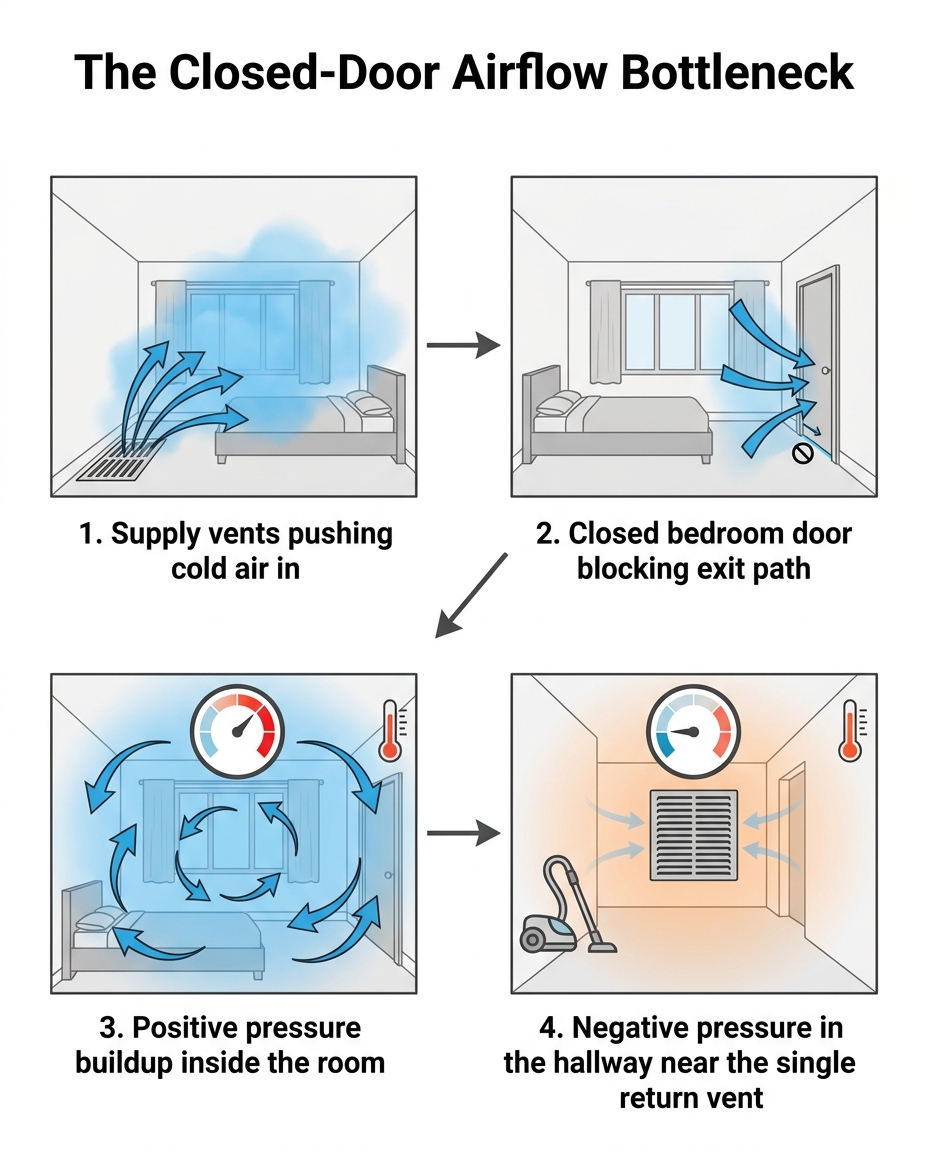
However, the moment you close a bedroom door, you sever that critical pathway. The supply vent continues trying to pump cold air into the bedroom, but the warm air inside has nowhere to go. Because the air cannot escape, it begins to build up inside the room. This creates a phenomenon known as "positive pressure."
Positive pressure acts like an invisible wall. The room becomes a pressurized bubble that physically blocks new, cold air from entering through the supply vent. At the same time, the hallway where the single return vent is located experiences "negative pressure" because the system is starved for air, causing it to suck in unconditioned air from outside through cracks and gaps. When you start addressing poor airflow from AC vents, looking at the return side of the equation is just as critical as checking the supply side.

Why Older Des Moines Neighborhoods Are Prone to Stagnant Air
Having worked extensively throughout the area, we know firsthand how the architectural history of our region plays a massive role in how comfortable your house feels today. Older Des Moines neighborhoods feature heavily in construction eras that predate modern, rigorous HVAC building codes. When these historic and mid-century homes were built, multi-return systems were not the industry standard. Builders relied on a simpler, cheaper method to allow air to flow back to the central unit: undercut doors.
An undercut door simply means there is a gap of about an inch or more between the bottom of the interior door and the floor. In theory, this gap provides enough space for air to slip underneath the closed door and travel back to the hallway return vent. In practice, however, our team rarely finds these gaps sufficient for modern cooling demands.
Today's high-efficiency air conditioners move larger volumes of air at higher velocities than the systems of the 1950s and 1960s. Forcing hundreds of cubic feet of air per minute through a half-inch gap under a bedroom door is like trying to drain a swimming pool through a drinking straw. The friction is too high, and the bottleneck remains.
This architectural quirk becomes painfully obvious during our local weather extremes. With hot, humid late summers regularly pushing heat indexes to uncomfortable levels, poor return airflow becomes severely noticeable. When the air in your bedroom stops moving, it stops passing over the indoor evaporator coil. Because air conditioners also serve as dehumidifiers, that trapped, stagnant air holds onto its moisture. A room that is 75 degrees with high humidity feels exponentially hotter, stickier, and more uncomfortable than a hallway that is 75 degrees and properly dehumidified.
The Myth of the 'Bigger AC' Solution
In our years of diagnosing airflow issues across Des Moines, we frequently see homeowners jump to a logical but incorrect conclusion when faced with a hot bedroom: the air conditioner must be too small or too old to do the job. This leads to the dangerous myth that buying a larger capacity AC unit will magically solve the problem of hot spots.
At Midwest Comfort Heating & Cooling, our approach focuses on accurately diagnosing and resolving the actual root causes of airflow issues, rather than immediately pushing unnecessary complete system replacements. If your home has a single return vent and you sleep with the bedroom doors closed, a larger air conditioner will not fix your hot rooms.
In fact, buying a bigger AC unit will likely make the problem much worse. If you have an airflow bottleneck, forcing a higher volume of cold air against a closed door just increases the pressure imbalance. The cold air still cannot get into the room.
Furthermore, oversized units create a new set of severe comfort issues. An oversized air conditioner will cool the open areas of your home (like the hallway and living room) far too quickly. This causes the system to "short-cycle," meaning it turns on, blasts cold air, and shuts off after just a few minutes. Because the system does not run long enough to pull humidity out of the air, your home is left feeling cold but incredibly clammy.
• Temperature Variance — Airflow Bottleneck (Single Return): Hallway is freezing, closed bedrooms are hot. — Oversized AC Unit (Short-Cycling): Entire house cools down too fast, but feels clammy.
• System Run Time — Airflow Bottleneck (Single Return): System runs constantly trying to cool the hot rooms. — Oversized AC Unit (Short-Cycling): System turns on and off rapidly (5-10 minute cycles).
• Humidity Levels — Airflow Bottleneck (Single Return): High humidity trapped only in closed rooms. — Oversized AC Unit (Short-Cycling): High humidity throughout the entire house.
• Solution Focus — Airflow Bottleneck (Single Return): Targeted ductwork and ventilation corrections. — Oversized AC Unit (Short-Cycling): Proper load calculation and equipment sizing.
Shifting the focus to targeted airflow corrections is the only permanent, scientifically sound way we recommend to eliminate positive pressure and restore comfort to your entire home.
Professional Corrections to Restore Balanced Air Pressure
Relieving positive pressure requires creating a clear, unobstructed pathway for hot air to leave the closed room and travel back to the central equipment. This is not a matter of simply cutting holes in walls; these modifications require professional calculation to ensure neutral pressure is achieved according to Department of Energy guidelines.
There are three primary structural solutions that our HVAC professionals typically implement to fix a single-return bottleneck.
Jumper Ducts and Transfer Grilles
1. Jumper Ducts: A jumper duct is an insulated, flexible tube installed up in your attic. It connects a ceiling grille inside the bedroom to another ceiling grille located out in the hallway. When the bedroom door is closed, the positive pressure pushes the warm air up into the bedroom ceiling grille, through the insulated tube, and down into the hallway where the main return vent can pull it in. Jumper ducts are highly effective because the sound-dampening insulation prevents noise from traveling between rooms, maintaining your privacy while allowing the HVAC system to breathe.
2. Transfer Grilles: A transfer grille is a simpler, through-wall vent that allows air to pass directly from the bedroom to the hallway or an adjacent open room. Typically, these are installed with offset grilles (one high on the bedroom side, one lower on the hallway side) to prevent light and sound from passing straight through. They are a cost-effective way to create an air pathway without running new ductwork all the way through the attic.
Dedicated Return Vents
3. Dedicated Return Lines: Adding dedicated return vents is the most comprehensive solution and the gold standard for multi-room temperature balance. This involves installing a new return grille in the hot bedroom and connecting it via new ductwork directly back to the main return trunk line at the furnace. Instead of dumping the air into the hallway, a dedicated return pulls the stagnant, hot air directly back to the equipment for re-conditioning. This guarantees neutral pressure and maximizes the cooling efficiency of the room.
The Impact of Trapped Air on Indoor Environmental Quality
While the temperature difference is the most obvious symptom we see in the field, the secondary consequences on your home's air freshness and health are equally significant. The airflow loop does more than just move heat; it is the primary mechanism for cleaning the air you breathe.
Your central heating and cooling system contains an air filter designed to capture airborne contaminants. However, that filter can only clean the air that is actually pulled through the ductwork. When a bedroom door is closed and the return pathway is blocked, the air inside that room becomes entirely stagnant.
Without constant circulation, rooms with closed doors quickly accumulate dust, pet dander, volatile organic compounds (VOCs) from furniture and cleaning supplies, and carbon dioxide from exhaled breath. If you have ever walked into a teenager's closed bedroom in the morning and noticed a distinct, stale odor, you are experiencing the direct result of trapped, unfiltered air.
Proper return airflow is essential for pulling these airborne contaminants out of the bedroom and pushing them through the system's central filter. Linking balanced air pressure directly to improved indoor air quality means that fixing your hot spots will also make your entire home smell fresher, feel cleaner, and provide a healthier environment for your family.
Keeping Your Existing Airflow Pathways Clear
If you are currently living with a single-return system and are waiting for our team to make structural modifications, there are actionable steps you can take right now to maximize the efficiency of your existing setup. Keeping your pathways clear is critical to minimizing the positive pressure effect.
Here is what you should check in your home:
• Never block the central return grille: Because this single vent is responsible for pulling air from the entire house, it must be completely unobstructed. Do not place sofas, bookshelves, or large potted plants in front of a wall return. If your return is on the floor, ensure it is not covered by area rugs or heavy curtains.
• Check your undercut doors: If your home relies on the gap beneath the bedroom doors, you must keep that space clear. Installing thick, plush carpeting in a hallway or bedroom often eliminates this gap entirely, choking off the airflow. Likewise, avoid using draft blockers or heavy door sweeps on interior doors during the summer months.
• Maintain your blower motor: Moving air through a restrictive, single-return layout forces your blower motor to work incredibly hard. Scheduling routine HVAC maintenance ensures the motor is clean, lubricated, and operating at peak efficiency to move air effectively despite the architectural limitations of the house.
• Keep doors cracked when possible: Whenever privacy is not strictly required, leave bedroom doors open an inch or two. Even a small opening relieves the positive pressure bubble and allows the cold air to enter the room.
Frequently Asked Questions About Home Airflow and Hot Spots
Why does closing my bedroom door make it hot?
Closing your bedroom door traps the air inside, creating a pressurized environment that blocks new air from entering. Your air conditioner's supply vent cannot push cold air into a room if the existing hot air has no pathway to escape back to the return vent. This lack of circulation causes the room to quickly stagnate and heat up.
Is one return vent enough for a house?
One central return vent is rarely enough for modern cooling demands, especially if interior doors are frequently closed. While older homes were built this way to save on construction costs, a single return relies entirely on open doors or large gaps under doors to function. Without dedicated return pathways from each room, the system will struggle to maintain even temperatures.
How do you fix a hot room with a closed door?
The most effective fix is to create a pathway for the trapped air to escape without opening the door. Professionals achieve this by installing jumper ducts in the attic, placing transfer grilles in the walls, or running a dedicated return duct straight from the bedroom back to the main HVAC system. These solutions relieve the pressure and allow cold air to flow in.
Can a single return vent cause high humidity in specific rooms?
Yes, a single return vent can absolutely cause localized high humidity. When a door is closed and airflow stops, the air inside the room no longer travels back to the air conditioner to be dehumidified. The stagnant air holds onto moisture from breathing and daily activities, making the room feel clammy and exponentially hotter than the rest of the house.
Do jumper ducts transfer noise between rooms?
Properly installed jumper ducts transfer very little noise between rooms. Because they are typically made from insulated, flexible ductwork and are looped up into the attic space, the insulation and the physical bend in the tube absorb sound waves. This makes them a great solution for maintaining both temperature balance and bedroom privacy.
Breathe Easier with Balanced Airflow in Your Home
Understanding the invisible airflow loop is the ultimate key to solving those frustrating late-summer hot spots. A clear, non-technical diagnosis of your home's positive pressure issues can save you from purchasing an oversized, unnecessary air conditioner. By exploring professional airflow corrections like jumper ducts or dedicated returns, you can ensure your home stays consistently comfortable all season long.
Customer Testimonials
Service Areas
