



The Hidden Dangers of Ignoring a Rattling AC Fan Motor Before Labor Day
Is That Rattling AC Unit Safe to Ignore Until Fall?
Is your outdoor AC unit suddenly making a loud, metallic rattling noise, leaving you wondering if it can just hold on for a few more weeks? You are not alone. As we enter late August in the Des Moines area, the pre-Labor Day cooling season brings a specific kind of homeowner fatigue. Your air conditioner has been running hard for months, the kids are heading back to school, and the last thing you want to deal with is a sudden mechanical issue. The temptation to ignore the hidden dangers of ignoring a rattling AC fan motor before Labor Day is incredibly strong. After all, if the house is still cool, how bad could it be?
The short answer is: it can be catastrophic. That rattling sound is not a harmless quirk of an aging system. It is a mechanical cry for help from components that are operating under immense stress. When faced with this dilemma, scheduling professional HVAC services is the only reliable way to know if that noise is a minor hardware issue or a major disaster waiting to happen. Waiting for the system to simply "turn off for the fall" is a gamble that frequently ends in complete system failure right as you are preparing to host holiday weekend gatherings.
The Anatomy of a Rattle: What Is Happening Inside Your Condenser?
To understand why that noise is so concerning, you have to look at what is actually happening inside your outdoor unit. The condenser relies on a heavy-duty, high-speed fan to pull massive amounts of air across the hot refrigerant coils, exhausting heat out of your home. This fan is not a gentle breeze-maker; it is a powerful piece of industrial equipment.
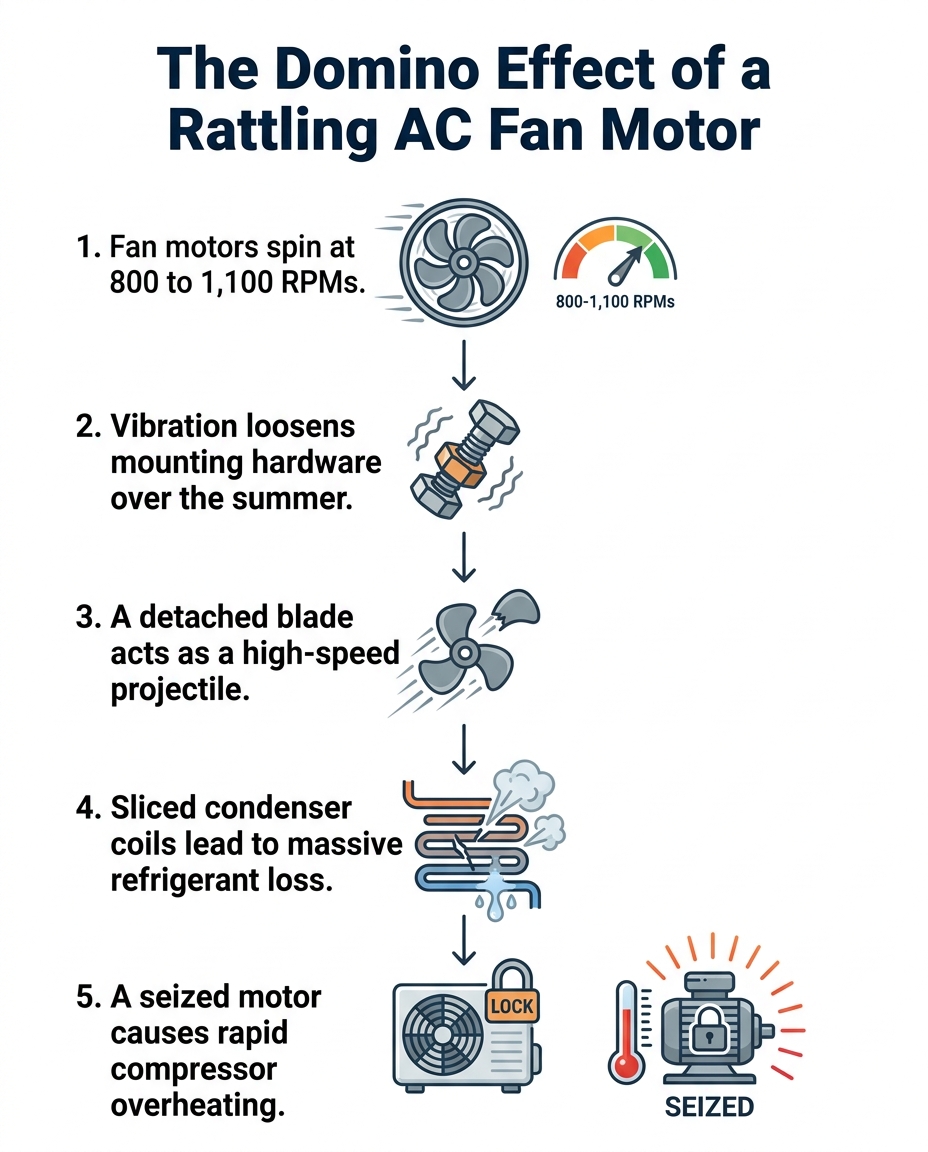
Because these fan motors typically operate at speeds between 800 and 1,100 RPMs (Revolutions Per Minute), perfect physical balance is absolutely critical. After thousands of hours of operation over the summer, mechanical fatigue sets in. When troubleshooting common AC issues, professionals look for two primary internal culprits that cause a sudden, aggressive rattle.
Failing Motor Bearings
The motor spinning that heavy fan blade relies on sealed bearings to rotate smoothly. These bearings are packed with lubrication at the factory, designed to withstand intense heat and friction. However, after months of continuous operation in the Des Moines area, that lubrication eventually breaks down or leaks out.
• The early warning: A faint, low-pitched hum or buzzing sound that you might only notice when standing right next to the unit.
• The progression: As the metal-on-metal friction increases, the hum turns into a loud, metallic grinding or rattling noise.
• The final stage: The bearings completely disintegrate, causing the motor shaft to wobble violently before seizing up entirely.
Loose Mounting Hardware and Out-of-Balance Blades
Vibration is the enemy of tight hardware. Over the course of the summer, the constant, low-level vibration of the running motor slowly backs out the screws and bolts holding the motor mount and the fan guard in place.
Once a single bolt loosens, the entire fan assembly loses its structural integrity. The fan blade, which must spin perfectly true, begins to wobble slightly. At 1,100 RPMs, even a microscopic wobble generates a massive amount of kinetic energy. The blade starts striking the metal fan guard or the internal housing, creating a rapid-fire rattling sound that echoes through the metal cabinet.
The "Wait Until Fall" Trap During Late-Summer Heatwaves
It is incredibly tempting to adopt a "wait and see" approach when cooler fall weather is just around the corner. Most homeowners don't realize that components already weakened by months of heavy use are at their absolute most vulnerable point right now.
The Problem: You hear the rattle, but the air coming out of your vents is still cold. You decide to let the system ride until September, hoping it just holds together.
The Cause: Des Moines experiences heavy late August heat and humidity, which forces your air conditioner to run almost constantly. This relentless operation prevents the already-failing motor bearings from cooling down, accelerating the wear and tear exponentially.
The Solution: Addressing the noise immediately prevents a minor tightening job from turning into a total system replacement. Delaying the repair often guarantees a major breakdown on the hottest day of the month. One local homeowner experienced this firsthand when their system gave out completely on the absolute hottest day of the summer, right when local schedules are usually booked solid. Because they reached out early in the morning, a technician was dispatched by 11:30 a.m. and had the system running again within an hour, deploying targeted cooling solutions that saved their afternoon.
The Catastrophic Domino Effect: When a Loose Blade Detaches
If you choose to ignore a rattling fan blade, you are risking a specific, highly destructive mechanical domino effect. The clearances inside your condenser cabinet are incredibly tight. There is often only an inch or two of space between the spinning tip of the fan blade and the delicate components surrounding it.
High-Speed Projectiles Inside the Cabinet
When an unbalanced fan blade finally breaks its mounting hardware, physics takes over immediately. Here is the exact sequence of a catastrophic failure:
1. The fracture: The weakened metal of the fan hub or the loosened mounting bolts finally snap under the stress of the wobble.
2. The launch: The heavy metal or dense composite fan blade detaches from the motor shaft while spinning at top speed.
3. The impact: Because the blade is encased in a metal cabinet, it has nowhere to go. It instantly acts as a high-speed projectile, ricocheting violently around the inside of the unit.
Sliced Refrigerant Coils and Total System Loss
The most vulnerable component inside the cabinet is the condenser coil—a network of thin copper tubing wrapped in thousands of delicate aluminum fins. This coil holds your system's pressurized refrigerant.
When a detached blade strikes the condenser coil, it slices right through the soft copper tubing. This causes an immediate, massive loss of refrigerant into the atmosphere. You will hear a loud hissing sound, followed by warm air blowing from your indoor vents. Replacing a punctured condenser coil is one of the most extensive and avoidable repairs in the entire HVAC industry.

Debris Impact vs. Mechanical Failure After Midwest Storms
Not every rattle means your motor is dying. Late-summer Midwest storms frequently blow twigs, leaves, and debris into outdoor condenser units, which is a leading cause of sudden rattling sounds in the pre-Labor Day cooling season. It is important to differentiate between external interference and internal mechanical failure.
If a small branch drops through the top fan guard, the spinning blade will strike it repeatedly, creating a loud, chaotic clatter. While this sounds terrifying, it is often a much simpler fix than a failing motor bearing. However, you must never stick your hands or any tools through the fan guard while the unit is powered on.
Scheduling routine AC maintenance is the safest way to clear hidden debris and verify the health of the system. Here is how to tell the difference between the two common issues:
• Type of Sound — Debris Impact (External): Inconsistent clattering, slapping, or ticking. — Mechanical Failure (Internal): Consistent, rhythmic grinding, squealing, or heavy metallic rattling.
• Onset — Debris Impact (External): Usually sudden, immediately following high winds or a heavy storm. — Mechanical Failure (Internal): Gradual progression from a faint hum to a loud rattle over several weeks.
• Visual Signs — Debris Impact (External): You can often see twigs or leaves resting on the bottom of the cabinet. — Mechanical Failure (Internal): No visible obstructions; the fan blade may appear to wobble while spinning.
• Vibration — Debris Impact (External): The cabinet itself usually does not shake violently. — Mechanical Failure (Internal): The entire metal housing may vibrate or shudder visibly.
Compressor Overheating: The Ultimate Cost of Inaction
The fan blade gets all the attention because it makes the most noise, but the fan's primary job is actually to protect the compressor. The compressor is the heavy, black, dome-shaped component sitting at the bottom of the outdoor unit. It is the heart of your AC system, responsible for pumping pressurized refrigerant between the indoor and outdoor coils.
Compressors generate a massive amount of heat while they work. The fan pulls cooler outside air across the coils and the compressor itself to keep operating temperatures within a safe range.
If you ignore a rattling motor until it finally seizes and stops spinning altogether, the compressor will continue to run without any cooling airflow. Within minutes, the compressor will rapidly overheat. While modern systems have thermal overload switches designed to shut the unit down before it catches fire, repeated overheating will permanently burn out the compressor's internal windings. A burnt-out compressor essentially means the heart of the AC system has failed, requiring major intervention.
Another local homeowner noticed a severe system issue involving a failing outdoor unit late one summer evening and called it in at 10:00 p.m. A technician arrived first thing the next morning and resolved the mechanical failure within 30 minutes. By acting quickly rather than waiting for the system to fail entirely, they prevented long-term compressor damage and restored their home's comfort immediately.
Frequently Asked Questions About Rattling AC Units
Is it safe to run my AC if it's rattling?
No, running a rattling AC risks catastrophic damage to the entire outdoor unit. Continuing to run it can turn a minor hardware tightening job into a destroyed coil or a burnt-out compressor. If you hear a loud, metallic rattle, turn the system off immediately at the thermostat and call a professional.
What happens if an AC fan blade breaks?
When an AC fan blade breaks at high speeds, it becomes a dangerous, high-speed projectile inside the metal cabinet. It will violently strike the surrounding components, typically causing severe damage to the delicate condenser coil. This leads to massive, immediate refrigerant leaks and requires extensive repairs.
Why is my outside AC unit rattling?
The top causes of a rattling outdoor unit include debris trapped inside the cabinet, loose mounting screws, unbalanced fan blades, or failing motor bearings. Late in the summer season, vibration and continuous use frequently cause hardware to loosen, which throws the high-speed fan out of balance.
Can I just tighten the AC fan blade myself?
No, opening the condenser cabinet and working on high-voltage mechanical parts requires a licensed professional. There are extreme risks of electrical shock, and improperly balancing a fan blade will cause it to wobble even worse, leading to further damage when the unit is powered back on.
What does a failing AC fan motor sound like?
A failing fan motor usually starts as a faint hum or buzz that gradually grows louder over several weeks. As the internal bearings lose their lubrication and wear out, the sound progresses into a loud, metallic grinding, screeching, or heavy rattling noise that is impossible to ignore.
Secure Your Labor Day Weekend Comfort Before the System Fails
A rattling noise from your outdoor unit is a clear warning sign, not just a nuisance you can push off until the weather cools down. Addressing a loose blade or a failing bearing right now is the only way to prevent a ruined holiday weekend. The hidden dangers of ignoring a rattling AC fan motor before Labor Day range from punctured coils to a completely burnt-out compressor, turning a simple service call into a major headache.
Don't let a mechanical failure dictate your end-of-summer plans. With 24/7 emergency service availability and prompt local response, you can rely on experts to quickly diagnose the rattle and secure your peace of mind. Schedule your air conditioning repair today to ensure your home stays cool, safe, and comfortable through the final heatwaves of the season.
Customer Testimonials
Service Areas
