



How We Address Weak Airflow in Two-Story West Des Moines Homes
The Challenge of Cooling Upper Levels During Late Summer
Your main floor feels like a refrigerator, but the moment you climb the stairs, you hit a wall of trapped, stifling heat. In our years of serving the Des Moines metro area, our team at Midwest Comfort Heating & Cooling has found that when local homeowners ask exactly how we address weak airflow in two-story West Des Moines homes, they are usually dealing with this exact daily frustration. The bedrooms are sweltering, the downstairs is freezing, and the thermostat becomes a battleground. This dynamic is especially punishing during the late August / end-of-summer heat, when daytime temperatures remain high and the back-to-school transition demands comfortable sleeping conditions.
For comprehensive HVAC services, our team focuses on correcting the root cause of these temperature imbalances. The most common reaction we see to a hot second floor is homeowners simply walking over to the main floor thermostat and dropping the temperature another three degrees. While this forces the air conditioner to run longer, it rarely solves the upstairs airflow problem. Instead, it wastes a massive amount of energy cooling unoccupied spaces while doing very little to push conditioned air to the upper bedrooms.
This leaves homeowners facing a clear decision point: continue relying on inefficient thermostat adjustments that freeze the downstairs, or invest in professional ductwork balancing to properly redirect the airflow. In our experience working in local neighborhoods, a hot second floor is rarely a sign of a failing air conditioner; rather, it is a widespread architectural and physical challenge that requires a targeted, professional solution.
Understanding Thermal Stratification in Midwest Climates
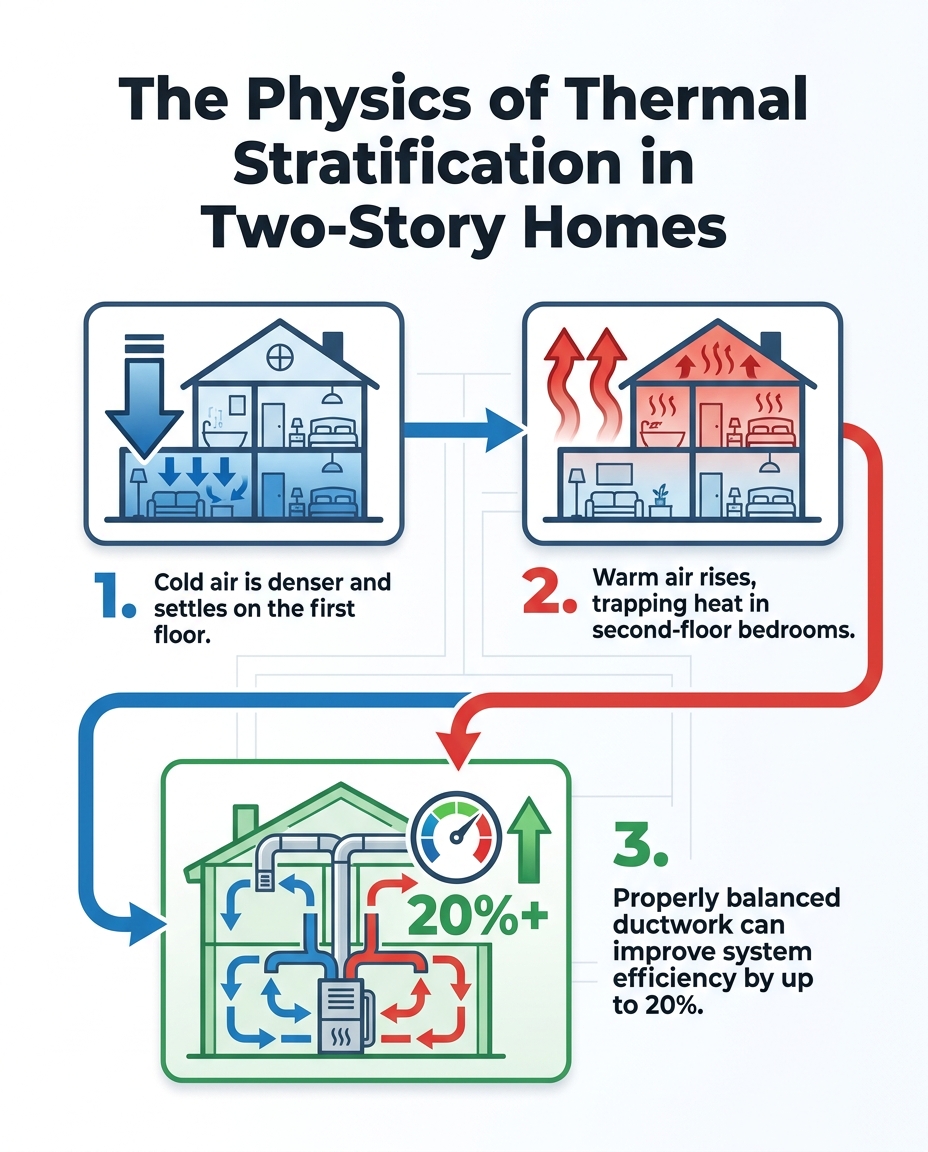
To understand why the upstairs stays so hot, you have to look at the basic physics of thermal stratification. Cold air is incredibly dense and heavy, causing it to naturally sink and settle on the lowest levels of a house. Warm air, being much lighter, rises to the top. As we frequently explain to our customers, this natural scientific process works directly against your air conditioning system in West Des Moines two-story homes.
During the late summer, the high humidity in the Des Moines metro area exacerbates this feeling. Moisture in the air holds onto heat, making the trapped upper-level air feel even heavier, stickier, and more oppressive. When you combine the natural rising of warm air with the heavy moisture content of an Iowa summer, the second floor becomes a heat trap.
Even a brand-new, properly sized air conditioning unit can struggle to push dense, heavy cool air up to the second floor against the force of gravity. The blower motor has to work incredibly hard to move that conditioned air vertically. If the ductwork is not perfectly balanced to account for this vertical climb, we often find that heavy cold air simply spills out of the first-floor vents because it takes the path of least resistance. Recognizing these early signs is the first step in addressing poor airflow from AC vents before the system is pushed beyond its limits.
• Second Floor — Air Density: Light & Humid — Temperature Behavior: Traps rising heat; feels sticky — HVAC Impact: Requires higher pressure to reach
• First Floor — Air Density: Dense & Heavy — Temperature Behavior: Cools quickly; air settles here — HVAC Impact: Receives excess airflow naturally
• Basement — Air Density: Heaviest — Temperature Behavior: Remains naturally chilled — HVAC Impact: Often over-cooled without dampers

Why Cranking Down the Thermostat Isn't the Answer
When the upstairs is sweltering during the late August / end-of-summer heat, the most natural instinct is to push the thermostat down to 68 degrees. However, pushing an AC unit to its absolute limits does not fix underlying airflow distribution problems. It only masks the symptom while creating entirely new issues for your equipment.
One local homeowner reached out to us during the hottest day of the summer when their air conditioner stopped working entirely. They had been steadily dropping the temperature to try and cool the second floor, and standard service companies were booked out. Our technician arrived by 11:30 am and had the overworked system running again within an hour. The root cause of the breakdown wasn't a flawed unit, but the immense strain of running continuously to overcome poor airflow distribution.
We constantly remind our customers that overworking the system on the hottest days of the year leads to unnecessary wear and tear on the compressor and blower motor. This constant runtime can freeze the evaporator coil or cause the system to short-cycle, potentially leading to unexpected breakdowns when you need cooling the most. Many homeowners assume they need a larger, more powerful AC unit to reach the second floor. In reality, our team has found that oversized units cool the first floor too quickly and shut off before the upstairs ever gets comfortable. What most homes actually need are targeted air conditioning solutions focused on airflow management.
The true cost of thermostat wars:
• Wasted Energy: Cooling an unoccupied first floor to frigid temperatures just to make the upstairs tolerable consumes massive amounts of electricity.
• Increased Wear: Continuous operation degrades moving parts faster than normal cycling.
• Humidity Issues: Systems that run constantly without proper airflow can struggle to dehumidify the home evenly.
Architectural Hurdles in Local Residential Developments
The layout and construction of your home play a massive role in how well it cools. Based on our extensive fieldwork, many modern and established West Des Moines two-story homes feature single-zone HVAC systems. A single-zone system uses one thermostat on the main floor to control the temperature for the entire house.
Single-zone systems are inherently challenged when trying to evenly cool multiple levels without specialized balancing. The thermostat only reads the temperature of the hallway or living room where it is mounted. Once that specific main-floor room reaches the target temperature, the system shuts off—regardless of whether the upstairs bedrooms are still 80 degrees.
Consider the actual journey the conditioned air must take. The air originates at the indoor unit, often located in the basement or a main-floor utility closet. It must travel through a maze of sheet metal, navigating elbows, junctions, and vertical climbs to reach the farthest upstairs bedroom. Every foot of ductwork and every turn reduces the velocity of the air. By the time it reaches the second floor, the airflow is often too weak to overcome the late August / end-of-summer heat pushing down on the roof.
These architectural quirks require targeted, localized expertise to overcome effectively. Because homes in the West Des Moines service area often share similar builder layouts and ductwork designs, our team at Midwest Comfort has developed a deep understanding of these specific structural hurdles, which is the key to restoring your comfort.
Our Professional Approach to Airflow Diagnostics
Guesswork has no place in residential heating and cooling. When dealing with temperature imbalances in West Des Moines two-story homes, a thorough, data-driven diagnostic process is required. Our technicians at Midwest Comfort approach airflow issues specific to local residential architecture by relying on professional measurement rather than assumptions.
This level of diagnosis goes far beyond generic troubleshooting, like simply changing an air filter or checking the outdoor condenser. We look at the respiratory system of the home itself.
1. Measuring Static Pressure: Just like a doctor checks your blood pressure, our technicians measure the static pressure inside the ductwork. This reveals how hard the blower motor is working to push air and identifies if the system is choking on restricted airflow.
2. Airflow Velocity Testing: Using specialized tools like anemometers, we measure the exact cubic feet per minute (CFM) of air coming out of the problematic upstairs vents. This provides a baseline data point to improve upon.
3. Ductwork Integrity Inspection: We evaluate the accessible ductwork for disconnected joints, severe leaks, or crushed flex ducts that might be bleeding cold air into the basement or attic before it ever reaches the second floor.
4. Damper System Assessment: We locate and assess the existing manual dampers within the trunk lines to see how they are currently directing air through the home's various zones.
By treating the late August / end-of-summer heat as a stress test for the home, our professional methodology pinpoints exactly where the airflow is being lost and what mechanical adjustments are needed to force it upstairs.
The Science of Duct Balancing and Damper Adjustments
In our experience, the most effective solution for weak upstairs airflow is professional duct balancing using HVAC dampers. Dampers are specialized, adjustable valves installed directly inside the main supply ductwork branches. Unlike the small directional levers on your floor or ceiling registers, inline dampers control massive volumes of air before it ever reaches the individual rooms.
The professional process of adjusting these dampers involves partially closing the valves that feed the naturally cooler main floor. By restricting the airflow downstairs, the system forces a higher volume of dense, conditioned air up the vertical trunk lines to the second floor. Duct balancing is a whole-home approach designed to ensure every single room receives the correct volume of air (CFM) required to maintain a uniform temperature, even during the late August / end-of-summer heat.
Why Balancing Requires Licensed Expertise
It is incredibly common to find online tutorials suggesting homeowners climb into their basements and start pulling damper levers. At Midwest Comfort Heating & Cooling, we explicitly warn against DIY damper adjustments. The static pressure within an HVAC system is a delicate, calculated balance.
We have seen firsthand what happens when an untrained individual closes off too many dampers to force air upstairs: the static pressure inside the ductwork skyrockets. The blower motor has to work against a wall of trapped air, which can cause the motor to overheat and burn out. Furthermore, restricting too much airflow across the indoor evaporator coil will cause it to freeze solid, completely shutting down the cooling process. Our licensed technicians use manometers to calibrate the system, ensuring that the dampers are adjusted enough to cool West Des Moines two-story homes evenly, without causing unintended strain or catastrophic equipment failure.
• Closing Dampers — DIY Risk: Skyrocketing static pressure; blown motors — Professional Standard: Measured restriction using manometers
• Closing Vents — DIY Risk: Freezing the evaporator coil — Professional Standard: Balancing airflow at the trunk line
• Increasing Fan Speed — DIY Risk: Humidity issues; excess noise — Professional Standard: Calibrating CFM to manufacturer specs
Long-Term Benefits of Properly Balanced Ductwork
Investing in professional duct balancing does more than just solve a temporary comfort issue. We find that it fundamentally changes how your HVAC system operates, providing benefits that last long after the late August / end-of-summer heat has passed.
Data from the U.S. Department of Energy indicates that properly sealed and balanced ductwork can improve system efficiency by up to 20%. When the airflow is correctly distributed, the thermostat on the main floor is no longer tricked into shutting the system down prematurely, and you no longer have to set it to 65 degrees just to feel comfortable upstairs. This balanced airflow drastically reduces the overall runtime of the AC unit, which saves a measurable amount of energy month over month.
Key benefits for West Des Moines two-story homes include:
• Better Sleep Quality: Consistent temperature distribution means the upper-level bedrooms stay cool and dehumidified during sticky summer nights.
• Extended Equipment Lifespan: Reduced runtime minimizes the daily wear and tear on the compressor, delaying the need for premature replacements.
• Quiet Operation: Properly balanced static pressure eliminates the loud "whooshing" or whistling sounds that often occur when air is forced through restricted vents.
Maintaining this delicate balance is a key part of ongoing system health. When combined with our routine HVAC maintenance, optimized ductwork ensures that your home is prepared for both the peak of summer and the depths of winter.
Frequently Asked Questions About Second-Floor Airflow
Why is my upstairs so hot even with the AC on?
Your upstairs is hot because cold air is dense and naturally settles on the lower levels, while warm air rises to the second floor. During the late August / end-of-summer heat, a single-zone thermostat on the main floor often shuts the AC off before the heavy, conditioned air can be pushed all the way up to the bedrooms. This creates a severe temperature imbalance in West Des Moines two-story homes.
Why is the airflow so weak in my upstairs vents?
Airflow is weak upstairs because the conditioned air must travel a long distance against gravity from the basement or utility closet to the second floor. Every turn and foot of ductwork reduces the air's velocity. Without professional duct balancing, the air takes the path of least resistance and spills out of the first-floor vents instead.
How can I increase AC airflow to the second floor?
The most effective way to increase airflow to the second floor is by having a professional adjust the inline HVAC dampers within your ductwork. By slightly restricting the airflow to the naturally cooler main floor, a technician can force more conditioned air up the vertical trunk lines to the upper bedrooms without damaging the system.
Does adjusting dampers help cool upstairs?
Yes, adjusting dampers is the primary method for redirecting airflow to the upstairs. Dampers act as valves inside the ductwork, allowing you to control the volume of air sent to different zones. However, this must be done carefully to avoid increasing static pressure to dangerous levels.
How do professionals balance HVAC dampers?
Professionals balance HVAC dampers by measuring the static pressure and airflow velocity (CFM) at various points in the system using specialized tools like manometers and anemometers. They make precise adjustments to the damper blades to ensure even temperature distribution while protecting the blower motor and evaporator coil from excess strain.
Can a single-zone HVAC system effectively cool a two-story home?
A single-zone system can effectively cool a two-story home, but only if the ductwork is perfectly sealed and professionally balanced. Because the system relies on a single thermostat, the ductwork must be calibrated to deliver the exact right amount of air to each level simultaneously to prevent the upstairs from overheating.
Restore Comfort to Your Upper Levels Before Summer Ends
Understanding the physics of thermal stratification in West Des Moines two-story homes is the first step, but our professional balancing is the ultimate solution. If your upper bedrooms are unbearable during the late August / end-of-summer heat, you do not have to resort to freezing out the main floor just to get a good night's sleep.
A hot upstairs doesn't automatically mean you are facing a costly AC replacement. Often, we find the equipment is perfectly capable of cooling the home; it just needs the airflow properly managed. Schedule a professional diagnostic with Midwest Comfort Heating & Cooling today to measure your static pressure, balance your ductwork, and ensure comfortable, consistent cooling across every level of your home.
Customer Testimonials
Service Areas
