



What Happens When You Call for 24-Hour HVAC Repair in Des Moines at 2 AM

Waking Up to an 85-Degree House: The 2 AM AC Crisis
Your air conditioner was running continuously all evening, but now the house is dead silent. You wake up sweating, check the hallway thermostat, and realize you are trapped in a sweltering 85-degree house. If you are wondering exactly what happens when you call for 24-hour HVAC repair in Des Moines at 2 AM, you are certainly not alone. At Midwest Comfort Heating & Cooling, our team has answered hundreds of these frantic late-night calls. During a severe July peak summer heatwave, cooling systems are pushed to their absolute limits, and in our experience, mechanical failures rarely happen during convenient business hours.
Staring at that blank or climbing thermostat, you face an immediate internal debate. Should you try to wait until morning and suffer through a miserable, sleepless night, or should you call for emergency dispatch right now? Many homeowners hesitate to pick up the phone because they simply do not know what to expect on the other end of the line. They worry about waking someone up, facing unknown fees, or dealing with a confusing process.
The reality is that our professional dispatch logistics are specifically designed to handle exactly these late-night crises efficiently. When you work with a dedicated team providing comprehensive HVAC services, the infrastructure is already in place to get your home cooling again. Understanding our step-by-step process of a 2 AM emergency call removes the anxiety from the situation, allowing you to make the best decision for your family's safety and comfort.
Step 1: Connecting with the Late-Night Dispatch Team
The most common fear homeowners have at 2 AM is that their call will drop into an unmonitored voicemail box. When you dial our emergency line in the Des Moines metro area, your call is routed to a live, trained professional whose specific job is to manage after-hours crises. They are awake, alert, and ready to help you navigate the situation.
Our dispatcher's primary goal is to assess the severity of your situation and prioritize the response. They will guide you through a brief but highly specific series of triage questions. This is not just small talk; every detail you provide dictates how our on-call technician prepares for your specific home.
Expect the dispatcher to ask you the following key questions:
• Current indoor conditions: What does the thermostat currently read, and is it actively climbing?
• System behavior: Is the unit completely dead, making unusual grinding noises, or running constantly while blowing warm air?
• Recent history: Did you notice any strange odors, flickering lights, or poor performance earlier in the day?
• Equipment age: Roughly how old is the central air unit sitting outside your home?
Gathering Critical System Details
The dispatcher needs to know whether the system is completely unresponsive or just struggling to keep up. A unit that is blowing warm air often points to a different set of mechanical failures than a unit that will not turn on at all. By gathering these accurate details upfront, our team ensures the on-call technician pulls the correct specialized diagnostic tools and common replacement parts before ever leaving for your property. This immediate, calm assessment sets the stage for a rapid resolution.
Step 2: Upfront Communication of After-Hours Policies
One of the biggest reasons homeowners suffer through an 85-degree night is the fear of surprise fees. The HVAC industry has historically struggled with transparency, leaving panicked homeowners in the dark until a massive bill is presented at the end of the night. Our professional, authoritative dispatch completely flips this model.
When you request a dispatch at 2 AM in the Des Moines metro area, emergency after-hours rates do apply to cover the logistical costs of routing a technician in the middle of the night. However, a reputable team will communicate these policies conceptually and clearly before anyone is ever dispatched to your home. Midwest Comfort prioritizes total transparency regarding after-hours policies during the initial call, eliminating surprises and building immediate trust.
During this step, our dispatcher will clearly outline how the emergency dispatch process works and what the initial diagnostic parameters look like. You must explicitly approve these parameters before our technician is officially routed to your home. This upfront communication means you are entirely in control of the process. You are never pressured, and you never have to wonder what the baseline expectations are. By removing the financial mystery from the equation, you can focus entirely on getting your home comfortable again.
Step 3: Safe, Immediate Triage Instructions While You Wait
Once the technician is confirmed and routed, you might feel tempted to start inspecting the equipment yourself. Do not open the access panels. Internal HVAC components carry high voltage and require a licensed professional to handle safely. However, there is one absolutely critical action you must take while waiting for our team to arrive during a July peak summer heatwave: you must turn off the malfunctioning air conditioner at the thermostat.
Our technicians frequently see minor repairs turn into catastrophic equipment failures because a struggling system was left running. If the system is low on refrigerant, blowing warm air, or making grinding noises, forcing it to run can cause severe compressor overheating and extensive electrical damage.
Why Shutting Off the Thermostat is Crucial
Department of Energy guidelines highlight the mechanical risks of forcing a compromised system to operate under load. When a component fails, the rest of the system works twice as hard to compensate. Preventing further mechanical damage is the single best way to ensure a faster, smoother repair once our technician arrives. Shutting the system down protects your investment.
While you wait, focus on safe comfort measures. Utilize ceiling fans to circulate the existing air in your home. Fans do not lower the room temperature, but the wind-chill effect on your skin provides temporary relief without putting any electrical load on your failing HVAC system.
• Turning the system to "OFF" at the thermostat — Unsafe Actions (Do Not Attempt): Removing the metal access panel on the outdoor unit
• Turning on ceiling fans and portable oscillating fans — Unsafe Actions (Do Not Attempt): Attempting to reset the high-voltage electrical breaker repeatedly
• Closing blinds and curtains to block morning sun — Unsafe Actions (Do Not Attempt): Touching the copper refrigerant lines to check for temperature
• Gathering maintenance records for the technician — Unsafe Actions (Do Not Attempt): Hosing down the outdoor unit while it is plugged in
Step 4: Realistic ETAs and Dispatch Timelines
When your house is stifling hot, every minute feels like an hour. Setting proper expectations for how quickly a technician can arrive is a vital part of our emergency process. During a peak summer emergency, exact arrival times are impacted by route logistics, your location within the Des Moines metro area, and the current volume of emergency calls.
To maximize efficiency, our technicians are dispatched directly from their on-call locations rather than a central warehouse. Advanced dispatch software calculates the fastest route across the city, minimizing travel time. Even during periods of extreme peak demand, our ultimate goal is rapid, same-night resolution whenever physically possible.
This commitment to speed is proven in the field by our team every season. Just last July, our on-call crew responded to a Des Moines homeowner who experienced a complete air conditioner failure during a severe heatwave. Because our dispatch team accurately triaged the severity of the situation, a Midwest Comfort technician arrived in under two hours and successfully completed the repair in less than an hour, restoring the home's comfort rapidly. While exact times vary based on the night's volume, our professional dispatch ensures you are never left waiting and wondering.
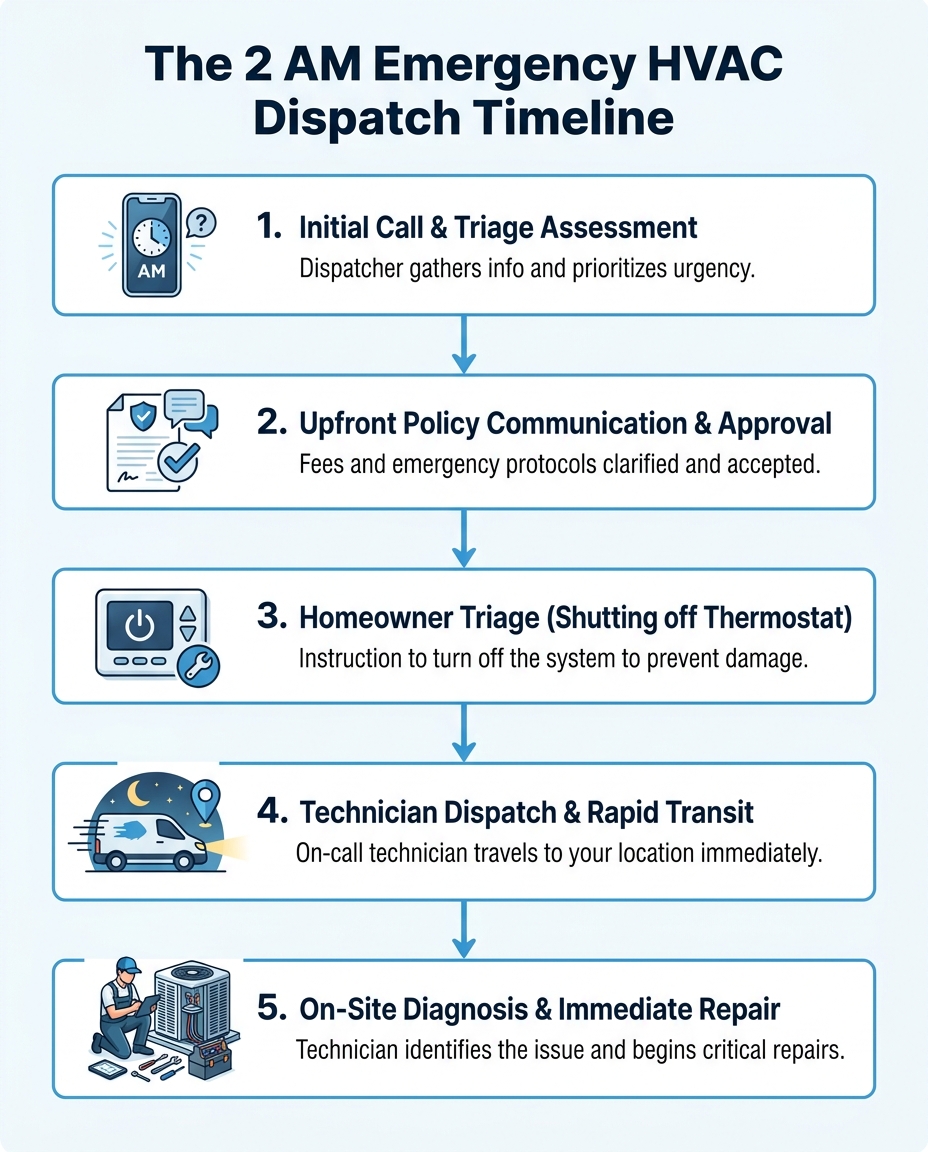

Step 5: Professional Diagnosis and Restoring Your Comfort
When our clearly marked Midwest Comfort vehicle finally pulls into your driveway, the resolution phase begins. The technician's arrival process is designed to be highly professional and respectful of your home during late-night hours. They will provide professional identification and take care not to disrupt sleeping family members any more than necessary.
The first priority is a rapid, accurate diagnostic process. Our technician will use specialized multimeters, pressure gauges, and thermal imaging tools to pinpoint the exact cause of the failure. Because they already have the triage notes from our dispatcher, they know exactly where to start looking. Whether the issue is a blown dual run capacitor, a locked-up fan motor, or a tripped contactor, the diagnostic phase is thorough and data-driven.
You will not be left waiting for parts the next day if it can be avoided. Our emergency vehicles are heavily stocked with universal and brand-specific replacement parts to facilitate immediate, one-trip repairs for the vast majority of common breakdowns. When you rely on our professional air conditioning services, the goal is to fix the problem right then and there.
Before any wrenches are turned, our technician will explain the specific issue they found, why it happened, and exactly what is required to fix it. Once you give the green light, they initiate the actual repair work, test the system under load, and monitor the temperature drop at your vents to ensure the July peak summer heatwave stays outside where it belongs.
The Hidden Danger of High Overnight Humidity
You might be tempted to simply open the windows and wait for morning, but our experience with regional climate data shows why this is often a dangerous choice. According to National Weather Service data, summer nights in the Des Moines metro area frequently maintain temperatures well above 70 degrees. More importantly, the overnight humidity index rarely drops.
High overnight humidity prevents your home from cooling down naturally. Even if the outside air feels slightly cooler than your 85-degree living room, introducing 80% humidity into the house makes it physically harder for your body to sweat and regulate its own temperature. Furthermore, the phenomenon of urban heat retention means your home's attic, walls, and foundation continue radiating the heat they absorbed all afternoon directly into your living spaces.
Because natural cooling is virtually impossible under these specific regional conditions, immediate professional intervention becomes a safety necessity rather than just a luxury. Our emergency crews see the impact of this extreme weather constantly. During a recent peak summer heatwave, our team responded to a local family facing a complete AC failure on the absolute hottest day of summer. Recognizing the safety risk of an un-air-conditioned home in those conditions, our team ensured a technician arrived rapidly, and the system was fully repaired within an hour. When extreme heat and humidity trap your home, waiting is simply not a safe option.
Frequently Asked Questions About Late-Night AC Failures
What happens when you call an HVAC emergency line?
When you call us, your call is answered by our live dispatcher who immediately triages your situation. They will ask specific questions about your thermostat reading and system behavior, explain our after-hours dispatch policies upfront, and route the closest available on-call technician to your home to begin repairs.
How long does emergency AC repair take in the middle of the night?
Most common electrical and mechanical repairs can be completed by our technicians in under an hour once they arrive. The exact arrival time depends on your location in the Des Moines metro area and the current volume of emergency calls, but we dispatch directly from on-call locations to minimize transit time.
What should I do while waiting for an AC technician to arrive?
The most important step is to turn your air conditioner completely off at the thermostat to prevent further damage to the compressor. After that, turn on ceiling fans to circulate air, keep exterior doors closed, and avoid opening the HVAC equipment panels yourself.
Is a broken AC considered an emergency if it happens at night?
Yes, especially during a July peak summer heatwave when high overnight temperatures and severe humidity prevent your home from cooling naturally. An indoor temperature climbing past 80 degrees poses a real safety risk to infants, the elderly, and pets, making immediate repair necessary.
Will turning off my AC at the thermostat harm the system?
No, turning off the system is actually the safest thing you can do. Forcing a malfunctioning air conditioner to keep running can cause catastrophic electrical damage and overheat the compressor. Shutting it down protects the internal components until our technician can diagnose the root problem.
Get Your Home Cooling Again Without the Guesswork
Understanding the precise logistics of a 2 AM dispatch removes the fear, uncertainty, and hesitation of calling for help in the middle of the night. You do not have to suffer through an 85-degree house wondering if anyone will answer the phone or if you will be hit with hidden fees. Our process is designed to be transparent, efficient, and entirely focused on getting your home back to a safe temperature.
When you are facing a severe breakdown in the Des Moines metro area, our team at Midwest Comfort Heating & Cooling stands ready. Do not let a late-night mechanical failure ruin your safety and comfort. If your system is currently blowing warm air or refusing to turn on, call for 24-hour HVAC repair immediately so we can restore your peace of mind.
Customer Testimonials
Service Areas
